

Are you struggling with Global Email Marketing Compliance? Navigating the complex, evolving web of data privacy regulations is now a crucial component of every successful digital campaign. Marketers face increasing pressure to understand multifaceted legal requirements and protect their brand’s reputation while building genuine engagement with their subscriber base.
This comprehensive guide breaks down the foundations of Global Email Marketing Compliance and arms you with everything you need—from understanding the core frameworks like GDPR and CCPA, to real-world tactics, advanced strategies, and emerging trends that can keep your campaigns compliant across all jurisdictions. You’ll gain actionable checklists, expert perspectives, and common mistake alerts—helping you not just avoid penalties, but also elevate your subscriber trust and inbox performance.
The Foundations of Global Email Marketing Compliance
Global Email Marketing Compliance has evolved far past the days of a formality or afterthought. In today’s interconnected world, where a single campaign can reach users across dozens of countries, compliance forms the very bedrock of digital trust and ethical brand behavior. Non-compliance doesn’t just risk significant fines; it can instantly erode your credibility, destroy hard-earned deliverability gains, and open you up to legal action and public backlash.
Recognizing the serious implications, forward-thinking organizations have shifted data privacy from a compliance-only issue to a core competitive advantage. Marketing and legal teams work hand-in-hand to ensure every email sent is compliant and consumer-centric.
Why Data Privacy Matters
Gone are the days when subscribers blindly exchanged their email for a quick discount. Modern consumers are far more vigilant—demanding clarity about how their information will be used, stored, and protected. Prioritizing Global Email Marketing Compliance communicates respect and transparency, cementing your brand as trustworthy. This, in turn, increases Subscriber Engagement Strategies, driving higher open rates, reduced opt-outs, and long-term customer loyalty.
Poor compliance doesn’t only bring legal headaches—it often translates to blocked emails, sender domain blacklisting, and being labeled as spam. Conversely, a reputation for strong compliance improves sender score, making sure your messages consistently land in the inbox rather than the spam folder.
Key Regulations Shaping Global Email Marketing Compliance

Achieving robust Global Email Marketing Compliance means deeply understanding how regulations differ, overlap, and evolve across borders. Here’s an expanded look at today’s major legal frameworks—with helpful context about how each impacts your global campaigns.
GDPR (General Data Protection Regulation)
Enforced across the European Union since 2018, the GDPR is the gold standard for personal data privacy. Its far-reaching nature impacts any company, anywhere, that collects or processes the data of EU citizens—regardless of physical location. Marketing under GDPR requires explicit, informed consent—users must actively “opt-in” (no more pre-checked boxes). The regulation grants “data subject rights,” such as data access, correction, and the famous “right to be forgotten.” GDPR also mandates prompt breach reporting and thorough record-keeping. If you cannot prove how and when you obtained consent, you risk massive fines, up to €20 million or 4% of your global turnover.
GDPR’s definition of personal data includes not just names and emails, but IPs, cookie identifiers, geolocation, website behavior, and more—meaning nearly all digital marketing activities fall within its scope.
CCPA (California Consumer Privacy Act)
The CCPA, in effect since 2020, is California’s answer to GDPR—though its requirements and consent models are distinct. CCPA’s primary aim is consumer empowerment: allowing users to know, access, delete, and opt out of the sale of their personal data. Unlike GDPR, it operates on an opt-out model. Businesses targeting California residents must clearly disclose what is being collected, offer a visible “Do Not Sell My Personal Information” link, and respond swiftly to consumer data requests. Notably, the CCPA’s reach means any business with sufficient California consumer data or revenue exposure (over $25 million/year) must comply. Enhanced penalties are applied for willful violations or data breaches involving minors.
CCPA compliance often compels email marketers to review their data mapping workflows and update their “Privacy Notices” frequently.
CAN-SPAM Act (US)
CAN-SPAM remains the federal law regulating commercial email in the United States. Compared to GDPR, CAN-SPAM is less stringent, allowing for implied consent—no explicit opt-in required. However, businesses must always honor opt-outs, present a physical address, and steer clear of deceptive subject lines and sender information. Recipients must be able to unsubscribe easily and requests must be honored within 10 days. Each violation can lead to fines of over $50,000. CAN-SPAM applies both to B2B and B2C emails and, coupled with various state-level rules, forms the backbone of compliance for U.S.-based marketers.
CASL (Canadian Anti-Spam Legislation)
Widely regarded as one of the strictest anti-spam laws worldwide, Canada’s CASL impacts every marketer sending emails to Canadian residents. CASL requires either explicit or implied consent to send any commercial electronic message. Implied consent is time-limited and generally only applies to existing business relationships. Explicit consent must be freely given, specific, and informed. CASL also mandates keeping records of consent and ensuring every message contains identification information and a simple unsubscribe mechanism. Violations can incur multi-million dollar fines per incident.
Global Expansion—Emerging Laws
Countries in Latin America (Brazil’s LGPD), Asia (Singapore’s PDPA), and the Middle East are also passing comprehensive privacy laws modelled on GDPR. International marketers need to continuously monitor regulatory updates to maintain Global Email Marketing Compliance at scale.
Global Email Marketing Compliance Comparison Table
|
Feature |
GDPR (EU) |
CCPA (California) |
CAN-SPAM (US) |
CASL (Canada) |
|---|---|---|---|---|
|
Consent Model |
Strict Opt-In |
Opt-Out |
Opt-Out |
Strict Opt-In |
|
Data Deletion/Access |
Yes (broad rights) |
Yes (specific) |
No |
No |
|
Right to Know Data Use |
Yes |
Yes |
Limited |
Limited |
|
Unsubscribe Requirement |
Immediate, prominent |
Immediate, prominent |
10 days to honor |
10 days to honor |
|
Physical Address Needed |
Yes |
Yes |
Yes |
Yes |
|
Penalties |
Up to €20M or 4% GR |
Up to $7,500/violation |
Up to $50,120/email |
Up to $10M CAD/violation |
Achieving Global Email Marketing Compliance
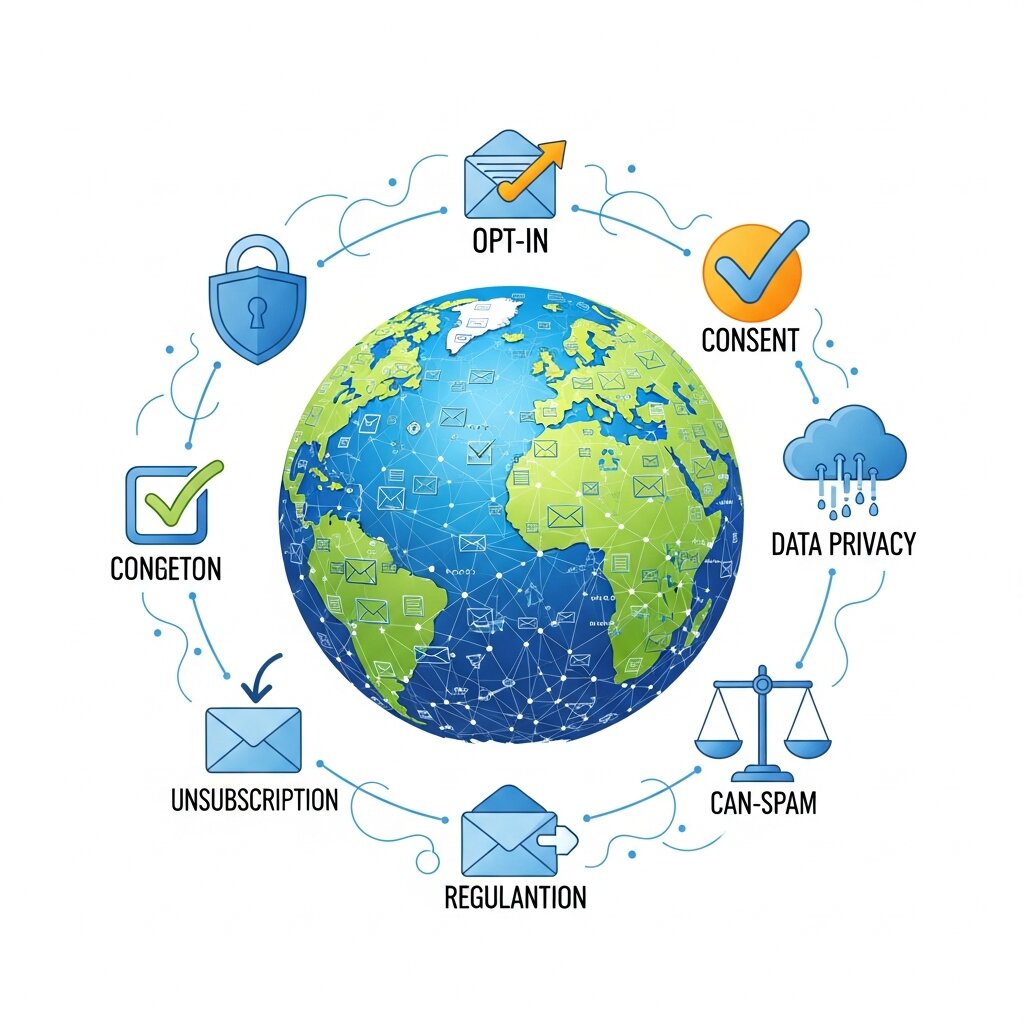
True compliance is not achieved with a checklist alone—it requires systems, staff training, and an adaptation of your entire marketing process to data-centric best practices.
1. Audit and Map Your Data
Start with a comprehensive data audit. Map out where and how you collect, store, process, and use subscriber data. Identify all systems—sign-up forms, CRMs, ESPs, analytics platforms. Recognize who has access (internal/external) and ensure each meets Global Email Marketing Compliance standards. Ensure your vendor contracts include Data Processing Agreements (DPAs).
2. Implement Double Opt-In
Double opt-in is the gold standard—after entering an email, subscribers receive a confirmation link to activate their subscription. This method dramatically reduces fake sign-ups, covers your compliance bases in strict regions, and improves list quality for better engagement and delivery rates.
3. Craft Transparent Consent Forms
Design sign-up forms that clearly communicate what data is collected, why it’s needed, and how it will be used (no legalese). Include links to your detailed privacy policy. Avoid mandatory fields that aren’t necessary for providing your service—collect only the minimum data required.
4. Simplify and Honor Unsubscribes
Never obscure or hide the unsubscribe link. Place it prominently in every communication. Process unsubscribes instantly whenever possible. Never require users to log in or navigate multiple steps—friction drives spam complaints and can result in violations. Consider adding a “preference center” so users can opt down for certain communications without fully unsubscribing.
5. Keep Accurate, Secure Consent Records
Store consent logs—including the subscriber’s IP address, timestamp, method, and the specific subscription language—for as long as you email that individual. This audit trail is essential proof if challenged by a regulator (especially under GDPR, CASL).
6. Be Fully Transparent About Data Usage
Update your privacy policy regularly to accurately reflect your practices—what’s collected, why, with whom it’s shared, and for how long it’s retained. Link to this policy clearly during sign-ups and in every campaign footer.
7. Maintain Secure, Updated Infrastructure
Utilize reputable, compliant email service providers trained in best practices. Ensure all transmissions are encrypted, limit employee access strictly, and promptly patch software for vulnerabilities. Data breaches can cause catastrophic compliance failures.
8. Educate and Train Your Team
Run mandatory privacy training for all marketing and customer-support staff. Ensure everyone understands not just the rules, but why they exist and how to spot issues before they turn into violations.
Common Mistakes to Avoid
Marketers often make costly errors when expanding globally or retrofitting legacy lists. Steer clear of these critical missteps:
- Buying Email Lists: Purchasing email lists from third parties is almost always a compliance violation. Grow your subscribers organically using value-driven content and clearly explained sign-up incentives.
- Weak Consent Practices: Using pre-ticked opt-in boxes or vague consent language leads to invalid subscriptions under GDPR/CASL and exposes you to complaints and scrutiny.
- Neglecting List Hygiene: Failing to purge unengaged or unknown contacts risks your sender reputation and exposes you to consent gaps.
- Missing Physical Address or Contact Info: Omit this simple footer requirement and you break nearly every global anti-spam law.
- Not Respecting Regional Differences: Sending the same campaign globally without segmenting for stricter regions (EU, Canada) can put all your marketing at risk.
- Inadequate Privacy Notices: Vague, outdated privacy policies fail modern standards and shake subscriber confidence.
- Slow Breach Responses: Under GDPR, you must inform authorities within 72 hours of discovery—delay can aggravate fines and increase reputational damage.
Expert Insights and Pro Tips
To go beyond the basics and truly master compliance, integrate these actionable recommendations:
- Regular Data Privacy Audits: Proactively review workflows, data processors, and storage practices at least twice yearly. As regulations evolve, so should your strategy.
- Advanced Segmentation: Use geo-location or self-selection fields to apply the strictest compliance rules (e.g., GDPR-level) only where mandated—or universally, for maximum simplicity and safety.
- Preference Centers: Allow subscribers to specify exactly what content they wish to receive. Letting users “opt down” instead of only “opt out” can extend the relationship while respecting consent.
- Automate as Much as Possible: Use marketing platforms that automate consent logs, unsubscribe processing, and audit reporting—minimizing manual errors.
- Monitor and Optimize Deliverability: Compliance boosts reputation, inbox placement, and ROI. Incorporate deliverability best practices such as SPF, DKIM, and regular sender score checks.
- Stay Current: Bookmark respected industry sites like GDPR.eu, the UK ICO, and DataGuidance. Subscribe to their updates and watch for shifts in requirements or new regional laws.
- Work With Legal Advisors: Consult with data privacy experts knowledgeable in your target markets to build scalable, regionally compliant strategies.
The Future of Global Email Marketing Compliance

Compliance isn’t a one-and-done achievement—it’s a continual process. As technology transforms how we interact and market, privacy expectations and laws will continue to strengthen. For example, Brazil’s LGPD, China’s PIPL, India’s DPDP, and other new laws are reshaping international data flows. There is also growing discussion of an eventual United States federal data privacy law, which could unify or surpass current state standards like CCPA and CPA (Colorado Privacy Act).
Forward-thinking brands adopt a “privacy by design” model, embedding compliance into product development, marketing, and support systems from the start. They view trust as a brand asset, not a side effect. The companies who thrive long-term will not just keep pace, but lead on transparency and customer respect.
Conclusion
Achieving Global Email Marketing Compliance is no longer optional or a low-risk gamble—it’s essential for sustainable growth, brand reputation, and customer trust. By rigorously understanding and applying the principles of GDPR, CCPA, CASL, and related laws, you prepare your business to meet customer expectations and withstand rapidly evolving global requirements. Audit your practices regularly, invest in staff training, and build privacy into every stage of your email marketing lifecycle. Begin now to secure your path to safe, effective, and respected global communication.
FAQs
1. What is Global Email Marketing Compliance?
Global Email Marketing Compliance refers to ensuring that your commercial emails align with all relevant international data privacy, anti-spam, and consumer protection laws (like GDPR, CCPA, CAN-SPAM, and CASL). Adhering to these rules not only avoids penalties but builds long-term trust.
2. Does the GDPR apply to businesses outside of Europe?
Yes. Any company, regardless of location, sending emails or collecting data from EU/EEA residents must comply with GDPR.
3. What is the difference between opt-in and opt-out consent?
Opt-in means users must actively subscribe (e.g., check a box). Opt-out means you may contact users until they unsubscribe. Local laws determine which method is allowed.
4. Is buying email lists legal?
No. Under most modern privacy laws (including GDPR and CASL), purchased or scraped lists are illegal, as there is no documented consent from recipients.
5. How quickly must I process an unsubscribe request?
Under CAN-SPAM, you have 10 days; GDPR and CCPA require prompt action. Best practice is immediate (automated) processing to demonstrate respect.
6. Do I have to include my physical address in every email?
Yes. Every major anti-spam law requires every marketing email to contain a current and valid postal address—this signals legitimacy and is a compliance must.
7. What is a double opt-in?
Double opt-in means a user signs up and must also confirm their subscription via a follow-up email—providing clear proof of consent and dramatically reducing spam and invalid sign-ups.
8. Can I use pre-ticked checkboxes for email subscriptions?
No. Only active, affirmative action—like manually checking a box—counts as valid consent under laws like GDPR and CASL.
9. What happens if I ignore Global Email Marketing Compliance?
Consequences include severe fines, blacklisting, criminal prosecution, breached sender score, diminished reputation, and possible lawsuits from privacy authorities or data subjects.
10. How do I maintain Global Email Marketing Compliance as my list grows?
Review compliance workflows regularly. Use automated systems for consent logging and unsubscription. Provide accessible privacy policy links, update your team, and periodically re-permission legacy lists to guarantee ongoing alignment with global laws.


I'm Email Campaign Manager who helps businesses design, execute, and optimize effective email marketing campaigns. With expertise in audience segmentation, campaign automation, and performance tracking, ensures emails reach the right audience and deliver measurable results.
















No Comments