


A good email open rate typically falls between 17% and 28%, depending on your industry. Anything above 20% is generally considered solid, while rates above 25% signal a highly engaged audience. Your ideal benchmark depends on your sector, audience type, and email purpose.
You sent the email. You crafted the perfect subject line. You hit “send” and waited. But when the results came in, you were left staring at a single number, wondering: is this open rate any good?
It’s a question almost every marketer asks. And the honest answer is—it depends. A 15% open rate might be disappointing for one industry but impressive for another. The purpose of your email matters too. A cold outreach campaign plays by very different rules than a newsletter sent to loyal subscribers.
This guide breaks down what a good email open rate looks like. You’ll find benchmarks by industry, learn how open rates compare to other key metrics, and pick up practical tips to boost your numbers. By the end, you’ll know exactly how your campaigns stack up—and what to do if they fall short.
What counts as a good email open rate?

A good email open rate generally sits between 17% and 28% across most industries. If your campaigns consistently hit 20% or higher, you’re doing well. Cross the 25% mark, and you’ve likely built an audience that genuinely wants to hear from you.
For a deeper breakdown of performance standards, you can explore what is considered a good email open rate, which explains benchmarks in more detail.
That said, “good” is relative. Open rates vary widely depending on three main factors:
- Your industry: A nonprofit newsletter and a retail promotion attract different levels of engagement.
- Your audience type: Engaged subscribers who opted in will open more emails than a cold list.
- Your email’s purpose: Transactional emails, like order confirmations, often see open rates above 40%, while promotional blasts tend to be lower.
One important note: Apple’s Mail Privacy Protection, rolled out in 2021, has made open rates harder to measure accurately. The feature automatically loads email images, which can register as “opens” even when no human actually reads the message. Because of this, many marketers now treat open rates as a directional signal rather than a precise figure.
What is the average email open rate by industry?
Open rates differ dramatically from one sector to the next. Comparing your performance against the right industry benchmark gives you a much clearer picture than relying on a single global average.
Understanding these benchmarks is especially useful when evaluating email marketing performance standards, since effectiveness often depends on context.
Here’s a general look at average open rates across common industries:
- Government and nonprofit: 28%–40% (often the highest, thanks to mission-driven, engaged audiences)
- Education: 25%–35%
- Healthcare: 20%–25%
- Real estate: 19%–22%
- Financial services: 20%–27%
- Retail and e-commerce: 15%–18% (high volume, but more competition for attention)
- Marketing and advertising: 17%–20%
- Technology and SaaS: 19%–22%
If you work in retail, don’t panic when you see lower numbers. The sheer volume of promotional emails consumers receive means open rates are naturally suppressed. What matters is how you compare to others in your own field.
What are reliable email marketing open rate benchmarks?

Email marketing open rate benchmarks act as a yardstick for measuring success. But not all benchmarks are created equal. The most useful ones account for your specific context rather than lumping every sender together.
When evaluating benchmarks, consider these factors:
- List quality: A clean, permission-based list will always outperform a purchased or outdated one.
- Send frequency: Sending too often can lead to fatigue and lower opens; sending too rarely can make subscribers forget you.
- Segmentation: Segmented campaigns consistently outperform one-size-fits-all blasts.
- Email type: Welcome emails, for example, average open rates of 50% or higher, far above standard newsletters.
A practical approach is to track your own historical performance alongside industry averages. If your typical open rate is 18% and you suddenly jump to 24%, that improvement is more meaningful than chasing an arbitrary external number.
How does cold email open rate average differ from regular campaigns?
Cold email plays by entirely different rules. Because you’re reaching people who haven’t opted in or don’t know your brand, expectations should be set accordingly.
To improve results, many marketers study how to write marketing emails that actually get results, since subject line quality and relevance directly influence opens.
The average cold email open rate typically falls between 15% and 25%, though well-targeted, personalized campaigns can climb higher. The key difference is that cold email success hinges heavily on a few specific elements:
- A compelling, personalized subject line that avoids spammy language.
- Sender reputation and deliverability, which determine whether your email even reaches the inbox.
- Relevance, since cold recipients have zero patience for irrelevant pitches.
If you’re running cold outreach, a 20% open rate is a strong result. Anything above 30% suggests you’ve nailed both your targeting and your subject lines. Just remember that cold email also carries higher deliverability risks, so monitoring your bounce and spam rates matters just as much as opens.
What are typical newsletter open rate statistics?
Newsletters occupy a unique space in email marketing. Since subscribers actively chose to receive them, newsletters tend to enjoy healthier open rates than promotional campaigns.
Newsletter open rates generally range from 20% to 30%, with the most engaging publications exceeding that. A few patterns hold true across successful newsletters:
- Consistency builds anticipation. Sending on a predictable schedule trains subscribers to expect and open your emails.
- Value comes first. Newsletters packed with genuinely useful content outperform thinly veiled sales pitches.
- Personality matters. Newsletters with a distinct voice often develop loyal readerships and stronger open rates.
If your newsletter open rate dips below 15%, it may be time to clean your list, revisit your content strategy, or re-engage inactive subscribers.
How do email open rates compare to click-through rates?
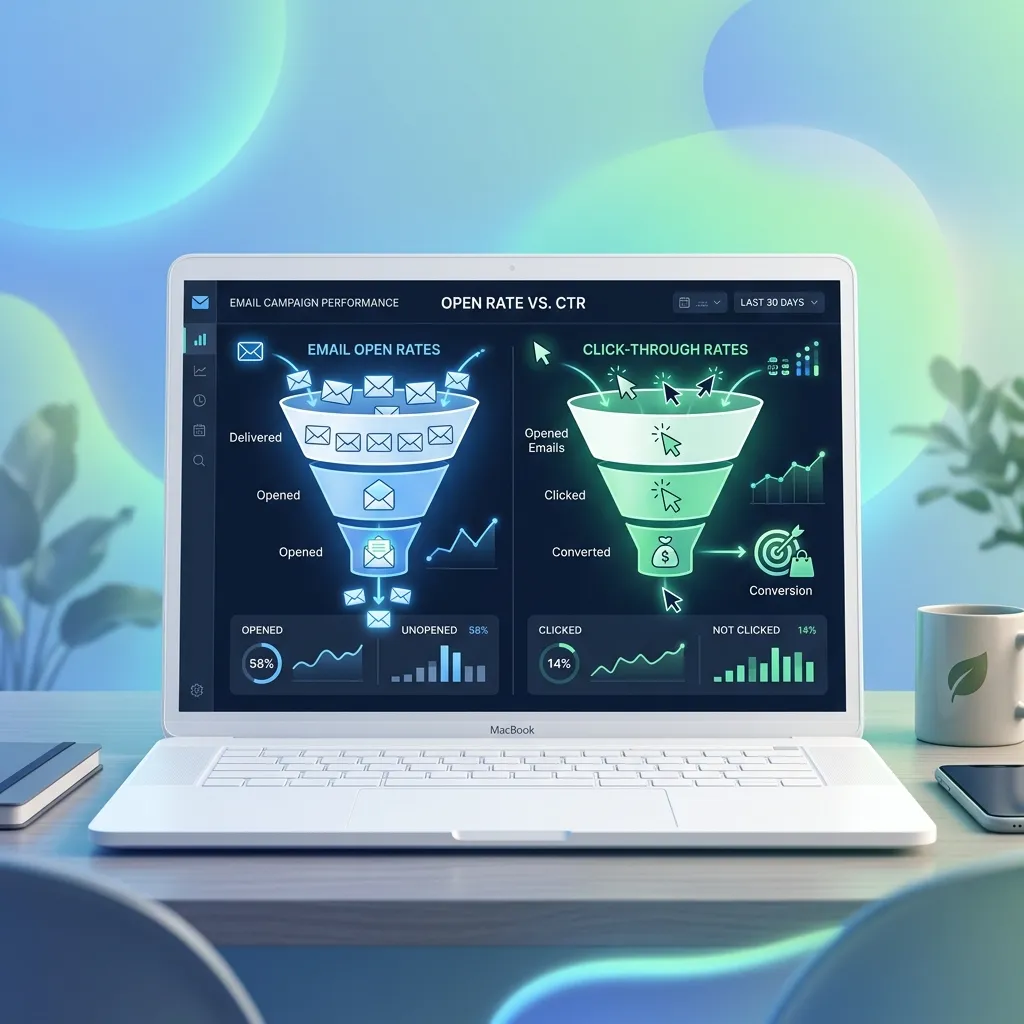
Open rate and click-through rate (CTR) measure two different stages of engagement, and confusing them leads to misguided conclusions. Understanding the email click-through rate vs open rate comparison helps you diagnose where your campaigns succeed or stumble.
- Open rate measures how many recipients opened your email. It reflects the strength of your subject line, sender name, and timing.
- Click-through rate measures how many recipients clicked a link inside your email. It reflects the quality of your content and call to action.
The average email click-through rate sits much lower than open rates—typically between 2% and 5% across industries. That gap is normal. Plenty of people open an email without clicking anything.
Here’s how to read the two together:
- High opens, low clicks: Your subject line is working, but your content or offer isn’t compelling enough.
- Low opens, high clicks among openers: Your content resonates, but your subject lines or deliverability need attention.
- Low on both: It may be time to rethink your list quality, segmentation, or overall strategy.
Because of open-rate tracking limitations, many marketers now lean more heavily on CTR and click-to-open rate (CTOR) as more reliable indicators of true engagement.
How can you improve your email open rates?
Knowing your benchmarks is only half the battle. The real value comes from improving your numbers. Here are proven tactics to lift your open rates.
Write subject lines that earn the open
Your subject line is the single biggest lever you can pull. Keep it clear, specific, and intriguing. Personalization—like including the recipient’s name or referencing their interests—can meaningfully boost opens. Avoid spam-trigger words like “free,” “guarantee,” and excessive punctuation.
Optimize your preview text
The preview text (or preheader) is the snippet of copy that appears next to or below your subject line. Treat it as a second headline. A strong preview text complements your subject line and gives readers one more reason to open.
Segment your audience
Sending the same email to everyone rarely works. Segment your list by behavior, demographics, or purchase history, then tailor your messages accordingly. Segmented campaigns consistently deliver higher open and engagement rates because they feel more relevant.
Clean your list regularly
Inactive subscribers drag down your open rates and can hurt your sender reputation. Periodically remove or re-engage contacts who haven’t opened your emails in months. A smaller, engaged list almost always outperforms a large, indifferent one.
Test your send times
Timing affects opens more than many marketers realize. Experiment with different days and times to find when your audience is most responsive. A/B testing send times across a few campaigns will reveal patterns specific to your audience.
Protect your deliverability
An email that lands in spam can’t be opened. Authenticate your domain, maintain a healthy sending reputation, and avoid practices that trigger spam filters. Strong deliverability is the foundation every other tactic builds on.
What other email campaign performance metrics should you track?
Open rate is a useful starting point, but it tells only part of the story. To measure true email engagement rate standards and overall success, track these metrics alongside it:
- Click-through rate (CTR): The percentage of recipients who clicked a link.
- Click-to-open rate (CTOR): Clicks divided by opens, showing how compelling your content is to those who opened.
- Conversion rate: The percentage who completed your desired action, such as a purchase or sign-up.
- Bounce rate: The percentage of emails that couldn’t be delivered.
- Unsubscribe rate: A high rate may signal content or frequency problems.
- List growth rate: How quickly your subscriber base is expanding.
Looking at these together gives you a far richer view of your email marketing success rate than any single metric can.
Putting your open rate in context
A good email open rate isn’t a fixed number—it’s a moving target shaped by your industry, audience, and email type. Aiming for 20% or higher is a reasonable goal for most senders, but the smartest approach is to benchmark against your own past performance and your specific sector.
Rather than obsessing over one figure, focus on the bigger picture. Improve your subject lines, segment your audience, keep your list clean, and watch how your open rates climb over time. Pair those gains with strong click-through and conversion tracking, and you’ll have a complete view of what’s actually working.
Start by pulling your last ten campaigns and calculating your average open rate. Compare it to the industry benchmarks above, pick one improvement tactic from this guide, and test it on your next send. Small, consistent tweaks add up to meaningful results.
Frequently asked questions
What is a good email open rate percentage?
A good email open rate is generally 20% or higher, with rates above 25% indicating a highly engaged audience. However, the ideal percentage varies by industry—nonprofits may see 30%+ while retail averages closer to 15%–18%.
What is the average email open rate across all industries?
The average email open rate across all industries typically falls between 17% and 21%. This figure shifts depending on the data source, audience type, and how opens are measured, especially given recent privacy changes that affect tracking accuracy.
Why are my email open rates suddenly dropping?
Open rates can drop due to poor list hygiene, declining sender reputation, deliverability issues, subscriber fatigue from over-sending, or weak subject lines. Apple’s Mail Privacy Protection can also distort reported numbers, so check whether the drop reflects real engagement changes.
Is open rate or click-through rate more important?
Both matter, but for different reasons. Open rate measures the strength of your subject line and timing, while click-through rate reflects how compelling your content is. Because open-rate tracking has become less reliable, many marketers now prioritize click-through rate and click-to-open rate as truer measures of engagement.
What is a good cold email open rate?
A good cold email open rate falls between 15% and 25%, with 20% considered a strong result. Personalized subject lines, solid sender reputation, and highly targeted lists are the biggest drivers of cold email success.
What is a good email open rate?
A good email open rate typically ranges between 17% and 28%, with anything above 20% considered strong for most industries.
What is the average email open rate across industries?
The average email open rate usually falls between 17% and 21%, depending on industry, audience quality, and email type.
Why do email open rates vary by industry?
Email open rates vary because different industries have different engagement levels, audience expectations, and email frequencies.
What is considered a low email open rate?
An email open rate below 15% is generally considered low and may indicate issues with subject lines, deliverability, or list quality.
How can I improve my email open rate?
You can improve open rates by writing stronger subject lines, segmenting your audience, optimizing send times, and cleaning your email list regularly.
What is a good email open rate for cold emails?
A good cold email open rate is typically between 15% and 25%, with personalization and targeting playing a key role in performance.
What is a good email open rate for newsletters?
Newsletter open rates usually range from 20% to 30%, especially when content is consistent and valuable to subscribers.
Do email open rates still matter?
Yes, but they are less precise due to privacy updates, so marketers often use them alongside click-through and conversion rates.
What affects email open rates the most?
The biggest factors include subject lines, sender reputation, list quality, email timing, and audience segmentation.
How do I know if my email open rate is good for my business?
Compare your results with industry benchmarks and your past performance to understand whether your email open rate is improving or declining.


I'm Email Marketer who crafts targeted campaigns that drive engagement, nurture leads, and boost conversions. With a passion for creating personalized email strategies.













No Comments