

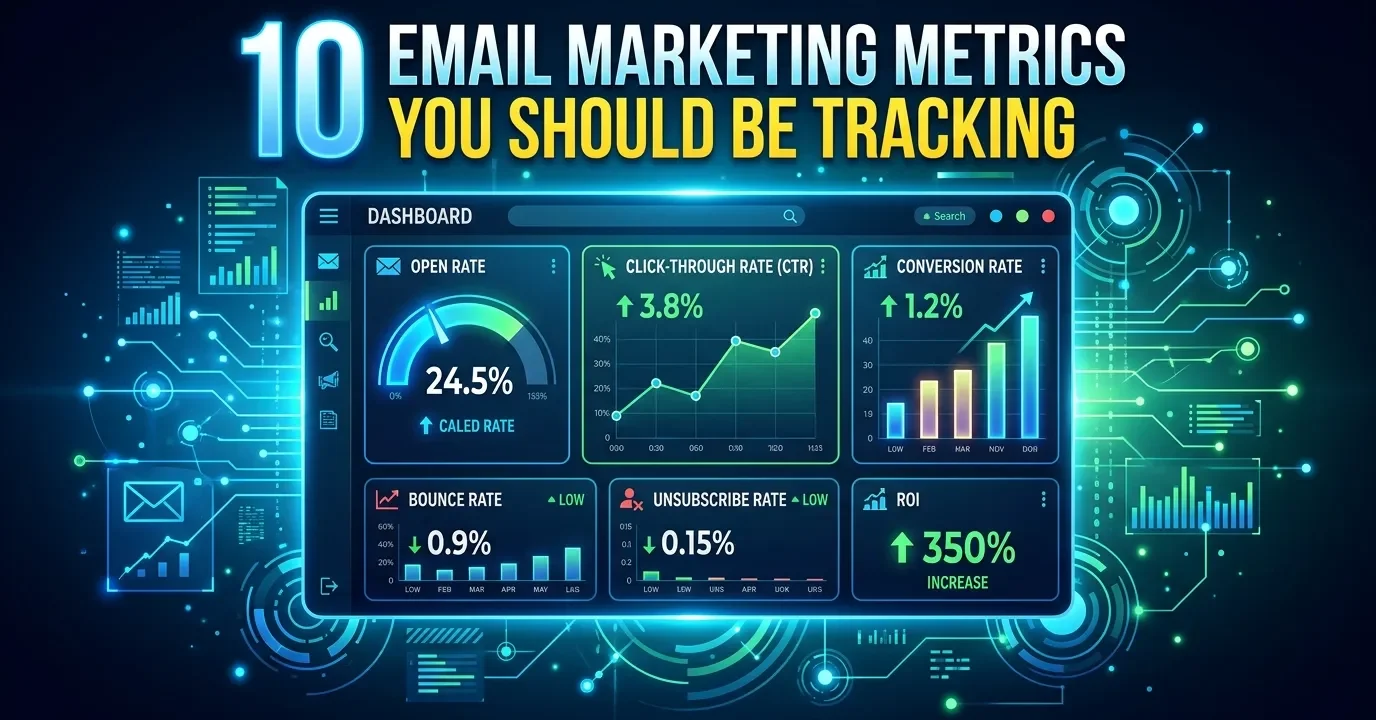
Email marketing metrics help businesses measure campaign performance and improve results. By tracking key metrics like open rate, click-through rate, conversion rate, bounce rate, unsubscribe rate, and deliverability, marketers can optimize engagement, increase conversions, and maximize email marketing ROI.
The most important email marketing metrics include open rate, click-through rate, conversion rate, bounce rate, unsubscribe rate, and deliverability metrics. Tracking these consistently helps marketers identify what’s working, fix what isn’t, and improve overall email ROI.
Email marketing remains one of the highest-returning digital marketing channels available. But sending emails without tracking performance is like driving with your eyes closed—you might be moving, but you have no idea where you’re headed.
The problem most marketers face isn’t a lack of data. It’s knowing which metrics actually matter, what benchmarks to aim for, and how to translate numbers into action. Open rates tell you one thing, conversion rates tell you another, and email deliverability metrics underpin all of it.
This guide breaks down the ten most important email marketing metrics, explains what each one means, and gives you a clear framework for improving your email campaign performance over time.
What is email open rate, and what’s a good benchmark?
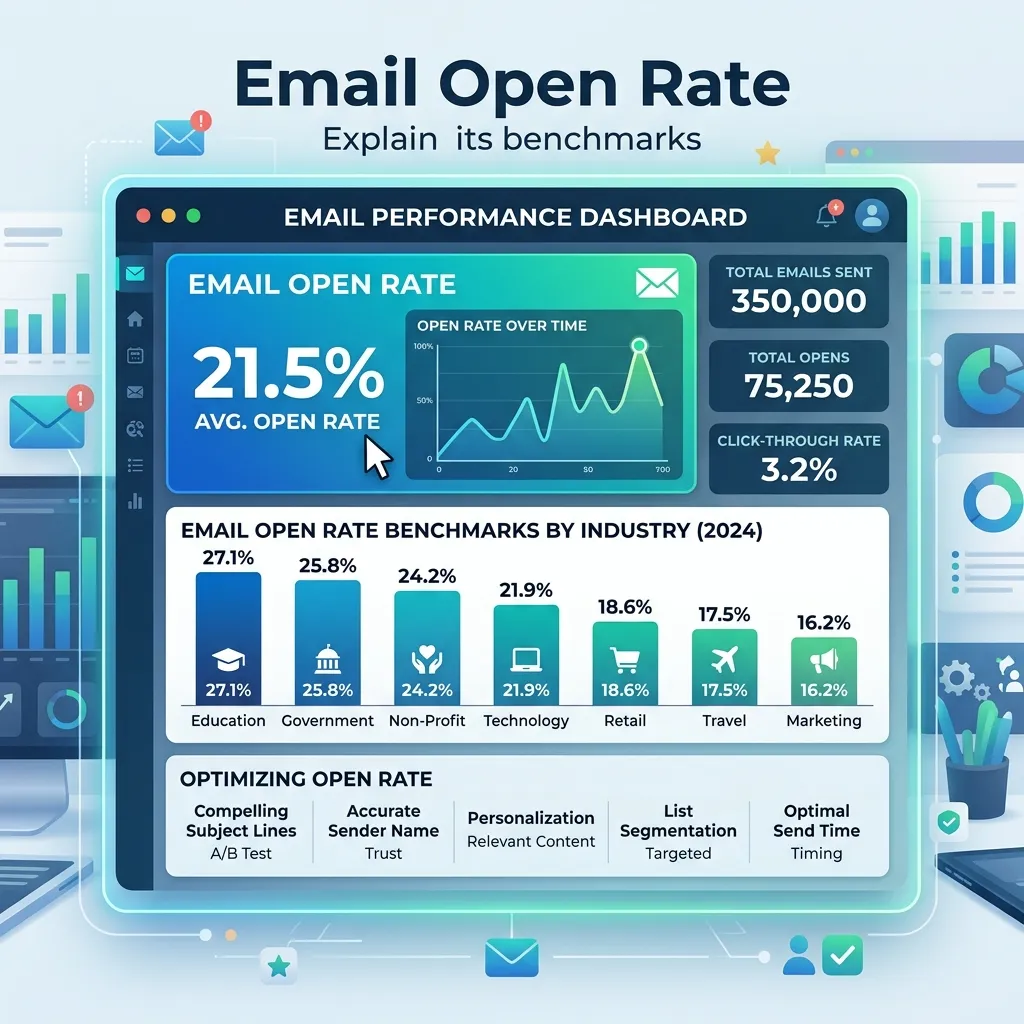
Email open rate measures the percentage of recipients who opened your email out of the total number delivered. It’s typically the first metric marketers check after sending a campaign.
How it’s calculated: (Emails opened ÷ Emails delivered) × 100
Open rates vary significantly by industry. According to Mailchimp, average open rates across industries range from roughly 19% to 28%. Government, nonprofit, and hobby-related emails tend to perform at the higher end, while e-commerce emails often sit lower. Understanding average email open rates and industry benchmarks helps marketers determine whether their campaigns are performing competitively.
A few things worth knowing about open rates: Apple’s Mail Privacy Protection, introduced to iOS devices, has inflated open rate figures for many senders, making this metric less reliable as a standalone indicator than it once was. Use it as a directional signal rather than a hard truth.
What drives open rates up:
- Strong, curiosity-driven subject lines
- Recognizable sender names
- Well-timed sending windows
- Clean, segmented lists
What is email click-through rate (CTR), and how do you improve it?
Email click-through rate (CTR) measures the percentage of recipients who clicked on at least one link in your email. CTR is one of the clearest indicators of whether your content is compelling enough to drive action.
How it’s calculated: (Total clicks ÷ Emails delivered) × 100
Average email CTRs typically fall between 2% and 5%, though this varies by industry and email type. Transactional emails—like order confirmations and password resets—tend to outperform promotional campaigns.
To lift CTR, focus on three areas: the relevance of your offer, the clarity of your call to action, and the visual hierarchy of your email design. A single, prominent CTA almost always outperforms a cluttered layout with five competing links.
Marketers looking to improve engagement can apply proven strategies to boost email click rates by improving personalization, content relevance, and CTA placement.
How do you measure email conversion rate accurately?
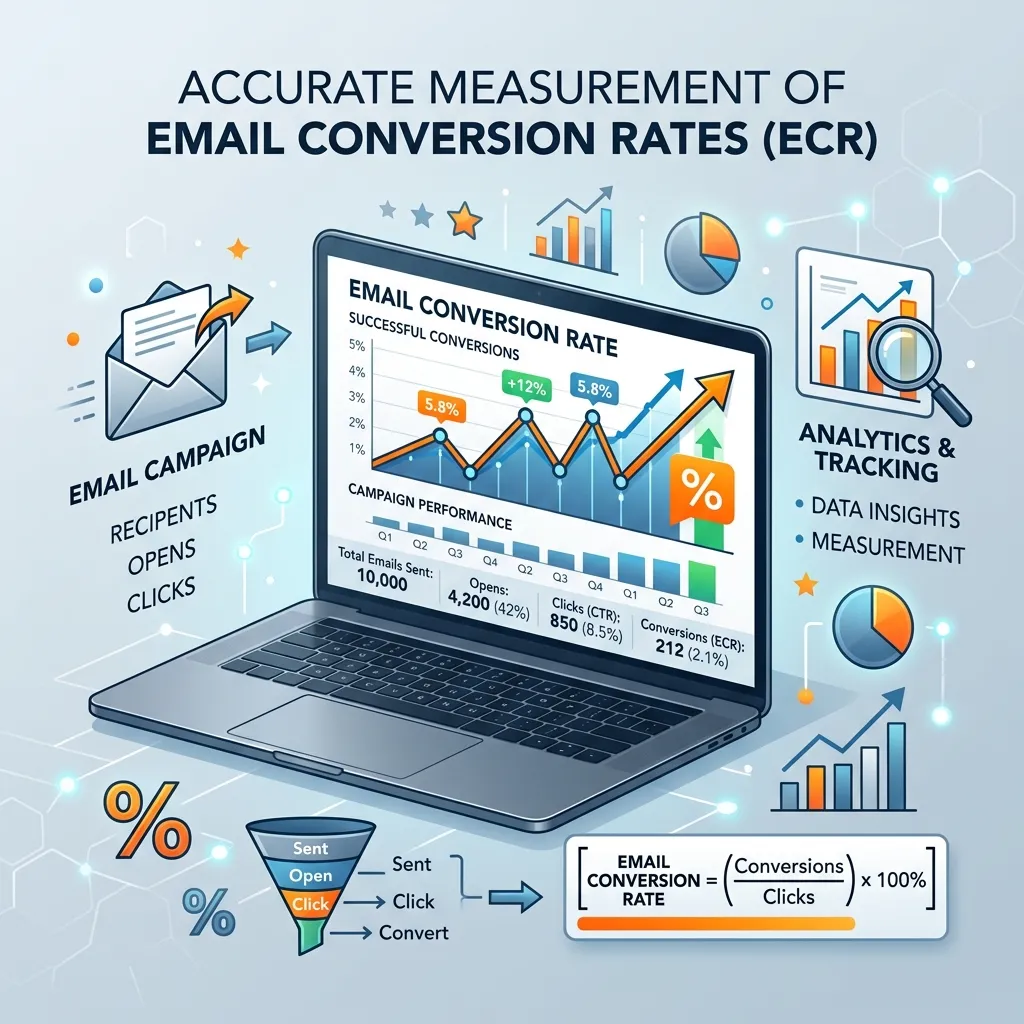
Email conversion rate tracks the percentage of recipients who completed a desired action after clicking through your email—whether that’s making a purchase, filling out a form, or booking a call.
How it’s calculated: (Conversions ÷ Emails delivered) × 100
This is arguably the most important email marketing metric because it connects your campaigns directly to revenue and business outcomes. Unlike open rates, conversion rate is harder to game—it reflects genuine engagement.
Accurate measurement requires proper UTM tracking parameters on your links and a configured conversion goal in your analytics platform (such as Google Analytics). Without this setup, you’re flying blind on what your email campaigns are actually generating.
Creating email campaigns that actually convert requires more than sending promotional messages. Successful campaigns combine audience targeting, persuasive copy, strong CTAs, and optimized landing pages.
What does email bounce rate reveal about your list health?
Email bounce rate measures the percentage of emails that failed to deliver. There are two types:
- Hard bounces: Permanent delivery failures caused by invalid or non-existent email addresses. These should be removed from your list immediately.
- Soft bounces: Temporary failures caused by a full inbox or a server outage. Most email platforms automatically retry soft bounced emails before flagging them.
How it’s calculated: (Bounced emails ÷ Emails sent) × 100
A healthy bounce rate sits below 2%. High bounce rates are a red flag for inbox providers—they signal poor list hygiene and can damage your sender reputation over time. Running regular list cleaning processes and using double opt-in during sign-up are two reliable ways to keep bounce rates low.
What does email unsubscribe rate tell you about audience fit?
Your email unsubscribe rate shows the percentage of recipients who opted out of your list after receiving a campaign. While no marketer enjoys watching subscribers leave, this metric carries useful diagnostic information.
How it’s calculated: (Unsubscribes ÷ Emails delivered) × 100
An unsubscribe rate below 0.5% is generally considered healthy. Spikes in unsubscribes often correlate with sending too frequently, messaging that doesn’t match audience expectations, or a poorly targeted segment.
One nuance worth noting: a low unsubscribe rate isn’t always a good sign. Some disengaged subscribers simply ignore emails rather than opting out. Monitoring engagement over time—not just unsubscribes—gives a more accurate picture of list health.
What are email deliverability metrics, and why do they matter?
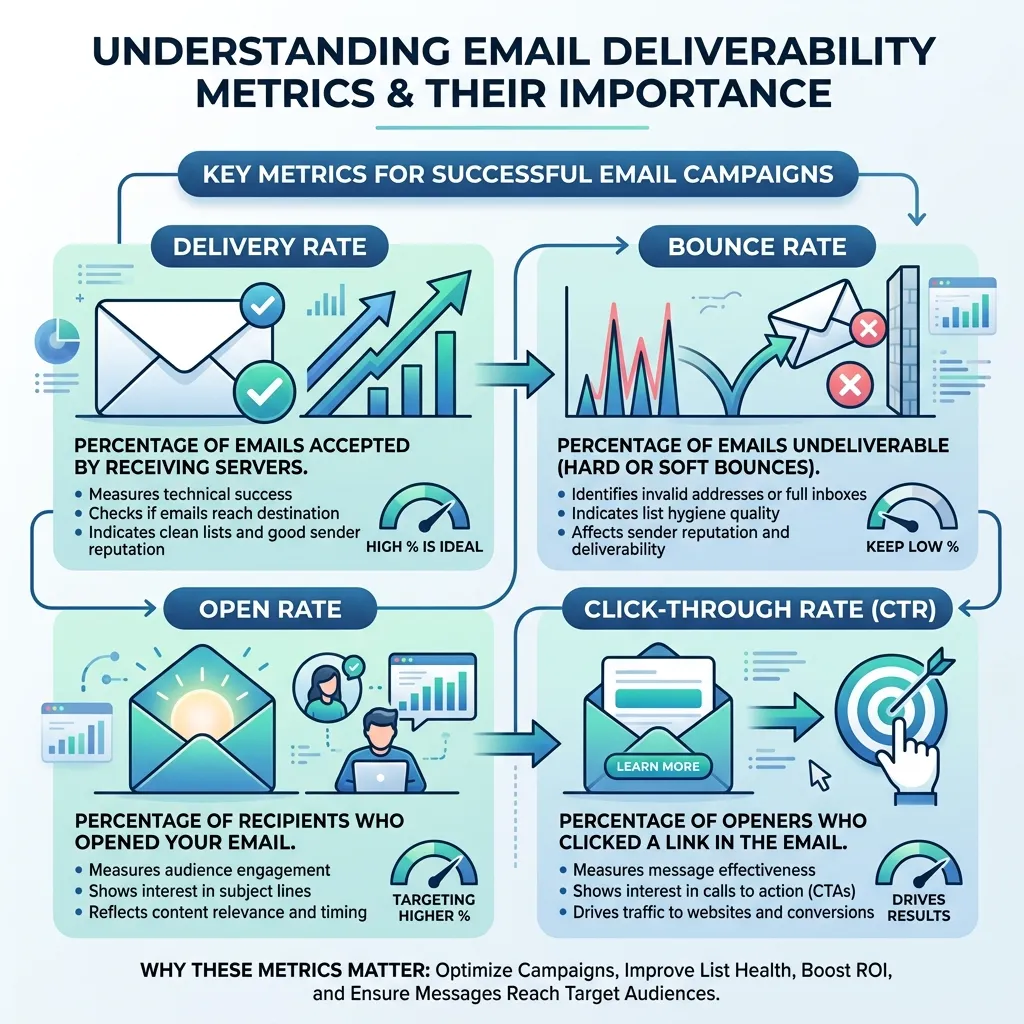
Email deliverability refers to your ability to land emails in the inbox rather than the spam folder. It’s the foundation that every other metric depends on—because if your emails aren’t being delivered, nothing else matters.
Key deliverability metrics include:
- Inbox placement rate: The percentage of emails that land in the primary inbox (versus spam or promotions tabs)
- Spam complaint rate: The percentage of recipients who marked your email as spam. Keep this below 0.1%.
- Sender reputation score: A score assigned by inbox providers based on your sending history, bounce rate, spam complaints, and engagement levels
Tools like Google Postmaster Tools, MxToolbox, and Sender Score allow marketers to monitor deliverability metrics. Consistently high engagement, low bounce rates, and authenticated sending domains (SPF, DKIM, DMARC) all contribute to a strong sender reputation.
How should you evaluate overall email campaign performance?
No single metric tells the full story of email campaign performance. Effective evaluation requires looking at a cluster of metrics together—open rate, CTR, conversion rate, bounce rate, and unsubscribe rate—in relation to each other and in the context of your campaign goals.
For example, a high open rate paired with a low CTR suggests your subject line is working but your email content or CTA is falling flat. A high CTR with a low conversion rate points to a disconnect between your email and the landing page experience.
Build a simple campaign scorecard that tracks these five core metrics for every send. Over time, this creates a benchmark against which you can measure improvement.
What are email engagement metrics beyond clicks and opens?
Engagement metrics go deeper than opens and clicks. They help you understand how subscribers interact with your emails over time.
Key email engagement metrics include:
- Read time: How long recipients spent reading your email (available in some ESPs)
- Scroll depth: How far down recipients scrolled
- Forward rate: The percentage of recipients who forwarded your email to others—a strong signal of high-value content
- List growth rate: How quickly your subscriber list is growing, factoring in new subscribers minus unsubscribes
How list growth rate is calculated: ((New subscribers − Unsubscribes) ÷ Total list size) × 100
Monitoring engagement metrics helps identify your most valuable segments—the subscribers who consistently read, click, and share. These are the people to prioritize when designing new campaigns or loyalty offers.
How do you use email marketing analytics to make better decisions?
Email marketing analytics is the practice of collecting, interpreting, and acting on email performance data. Most enterprise email service providers (ESPs)—including Klaviyo, HubSpot, Mailchimp, and ActiveCampaign—offer built-in analytics dashboards that surface key metrics automatically.
To make analytics actionable, follow this process:
- Set clear goals before each campaign. Are you driving sales, nurturing leads, or increasing event registrations? Your goal determines which metric is the primary KPI.
- Segment your reports. Break down performance by audience segment, device type, and geography to uncover patterns that aggregate data hides.
- Run A/B tests consistently. Test subject lines, send times, CTA placement, and email length to generate reliable performance data over time.
- Review trends, not just one-off results. A single email that underperforms is noise. A consistent downward trend in CTR is a signal worth investigating.
How do you calculate and improve email ROI?
Email ROI measurement quantifies the revenue your email program generates relative to what it costs to run. It’s the metric that makes the business case for investing in email marketing.
How it’s calculated: ((Revenue generated − Campaign cost) ÷ Campaign cost) × 100
To calculate this accurately, you need reliable conversion tracking, a clear attribution model, and cost data that includes both platform fees and the labor involved in creating campaigns.
Improving email ROI typically comes down to three levers:
- Increasing revenue per email: Better segmentation, personalization, and offers
- Improving deliverability: More emails reaching the inbox means more opportunities to convert
- Reducing cost per campaign: Automation, templates, and streamlined workflows
Email automation sequences—like welcome series, abandoned cart flows, and re-engagement campaigns—tend to deliver the highest ROI because they run continuously without requiring manual effort for every send.
Build a smarter email marketing program, one metric at a time
Understanding email marketing metrics is the difference between guessing and knowing. Open rate tells you about reach, CTR tells you about relevance, conversion rate tells you about results, and deliverability metrics tell you whether any of it is even getting through.
Start by auditing your current performance against industry benchmarks. Identify the two or three metrics that are furthest from where they should be. Then work backward—what’s causing the gap, and what’s one change you can test in your next campaign?
The marketers who consistently outperform their peers aren’t necessarily sending more emails. They’re sending smarter ones, guided by data.
Frequently asked questions
What is the most important email marketing metric?
Conversion rate is the most important metric for most businesses because it directly measures business outcomes—sales, sign-ups, or other goal completions. However, deliverability metrics form the foundation, since undelivered emails generate zero conversions.
What is a good email open rate?
A good email open rate is typically between 20% and 30%, depending on your industry. However, open rates have become less reliable since Apple’s Mail Privacy Protection inflates figures for senders with a large iOS audience. Use CTR and conversion rate as more dependable benchmarks.
How often should I review my email marketing analytics?
Review campaign-level metrics after every send, and conduct a deeper monthly analysis of trends across your full email program. Quarterly audits of list health—including bounce rate and engagement segmentation—are also recommended.
What causes a high email bounce rate?
High email bounce rates are usually caused by outdated or invalid email addresses on your list, poor list hygiene practices, or the absence of double opt-in during sign-up. Hard bounces should be removed from your list immediately to protect your sender reputation.
How do I improve email deliverability?
To improve email deliverability, authenticate your sending domain with SPF, DKIM, and DMARC records, maintain low spam complaint rates (below 0.1%), remove hard bounces promptly, and consistently send to engaged segments. Avoid purchased lists entirely.
What’s the difference between email CTR and click-to-open rate (CTOR)?
Email CTR measures clicks as a percentage of total emails delivered. Click-to-open rate (CTOR) measures clicks as a percentage of emails opened. CTOR is useful for evaluating content quality independently of subject line performance.


I'm Email Marketer who crafts targeted campaigns that drive engagement, nurture leads, and boost conversions. With a passion for creating personalized email strategies.














No Comments