

Abandoned Cart Emails help e-commerce businesses recover lost sales by reminding shoppers to complete their purchases after leaving items in their cart. This guide explains why customers abandon carts, how to build a high-converting email sequence, personalization strategies, best practices, and key metrics to improve conversions and maximize revenue.
Abandoned cart emails are automated messages sent to shoppers who leave a website without completing a purchase. When done well, they recover a significant share of lost revenue by reminding customers what they left behind, addressing hesitations, and offering a clear path back to checkout.
Every online retailer knows the feeling. A shopper browses your store, adds items to their cart, and then—nothing. No purchase. No explanation. Just a cart full of products sitting idle.
Cart abandonment is one of the most persistent challenges in e-commerce. According to the Baymard Institute, the average cart abandonment rate across industries sits at nearly 70%. That means roughly seven out of every ten shoppers who show genuine purchase intent walk away before completing a transaction.
The good news? A well-crafted abandoned cart email sequence can recover a meaningful slice of that lost revenue. Studies from Klaviyo show that abandoned cart emails generate, on average, $5.81 in revenue per recipient—making them one of the highest-performing automations in email marketing.
This guide breaks down everything you need to know: why shoppers abandon carts, what makes an abandoned cart email effective, how to structure a winning sequence, and the best practices that separate high-converting emails from the ones that get ignored.
Why Do Shoppers Abandon Their Carts?

Before writing a single word of copy, it helps to understand why abandonment happens. The Baymard Institute’s research identifies the most common reasons:
- Unexpected costs (shipping, taxes, fees) — cited by 48% of abandoners
- Forced account creation — 26%
- Slow or complicated checkout — 22%
- Lack of trust — 17%
- Insufficient payment options — 9%
This matters because your email copy should speak directly to these friction points. A shopper who left because of surprise shipping costs needs a different message than one who got distracted mid-checkout. The more your email addresses the real barrier, the higher your chances of winning the sale.
What Makes an Abandoned Cart Email Actually Work?
High-performing abandoned cart emails share a few core qualities. They arrive at the right time, say the right thing, and make it effortless to return to checkout.
Timing: When Should You Send an Abandoned Cart Email?
Speed matters. The first email in your sequence should go out within one hour of abandonment—this is when purchase intent is still warm and the shopper likely remembers what they were looking at.
Research from Rejoiner found that emails sent within 60 minutes of cart abandonment convert at roughly 6.3%, compared to just 2.5% for emails sent 24 hours later. The window closes fast.
For a three-email sequence, a proven send schedule looks like this:
- Email 1: 1 hour after abandonment
- Email 2: 24 hours later
- Email 3: 48–72 hours after that
Subject Lines That Actually Get Opened
Your subject line determines whether the email gets opened at all. The best abandoned cart subject lines are direct, specific, and just a little bit personal. A few proven approaches:
- Curiosity + urgency: “Your cart is about to expire”
- Direct reminder: “You left something behind, [First Name]”
- Social proof: “Others are eyeing what’s in your cart”
- Incentive tease: “Here’s 10% off what you left behind”
Avoid vague subject lines like “We miss you” or “Come back!” These perform consistently worse than lines that reference the actual product.
Email Copy: The Elements That Convert
The body of a winning abandoned cart email typically includes:
- A clear, friendly opening — Acknowledge what happened without being pushy
- Product image and name — Make it easy to remember what they were considering
- Social proof — A review or rating that reinforces product quality
- A direct CTA button — “Return to Cart” or “Complete Your Purchase”
- Trust signals — Free returns, secure checkout, or a money-back guarantee
Keep the copy concise. Shoppers are busy, and a wall of text won’t recover a sale. Lead with the product, address one or two hesitations, and make the return-to-cart action frictionless. Strong email copywriting that gets results can dramatically improve abandoned cart recovery rates.
How to Structure a High-Converting 3-Email Sequence
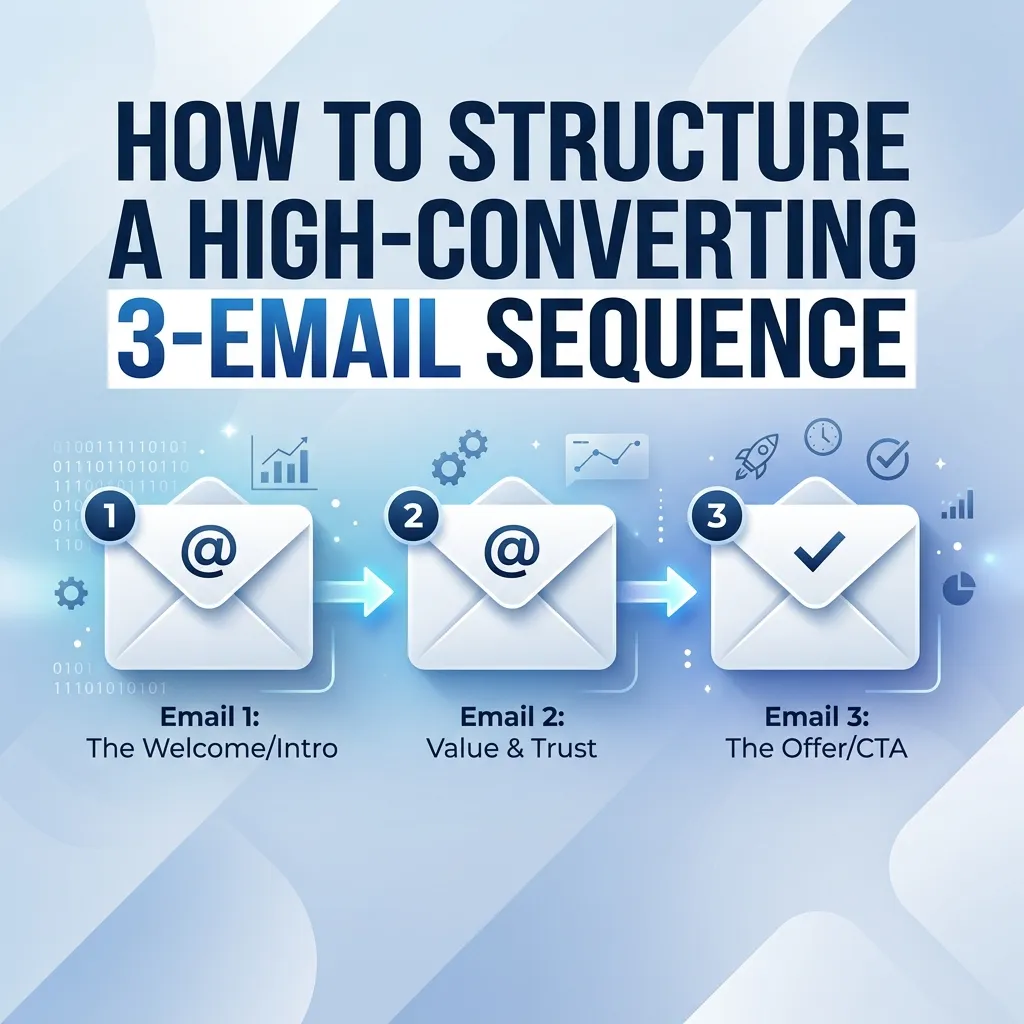
A single email is good. A strategic sequence is better. Here’s how to think about each touchpoint.
Email 1: The Gentle Reminder
The first email should be low-pressure and helpful in tone. The shopper may have simply gotten distracted—a simple reminder with the cart contents is often enough to bring them back.
Goal: Re-engage and remind
Tone: Friendly, no pressure
Key elements: Product image, cart summary, clear CTA
Incentive: Not yet—save it for later
Example subject line: “Did you forget something? 👀”
Email 2: Address the Hesitation
By the second email, the shopper has had time to think—and possibly look at competitors. This is where you build confidence in the purchase decision.
Lean on social proof here. Include a product review, a star rating, or a short testimonial. If your brand offers free returns, a price-match guarantee, or exceptional customer service, highlight these clearly.
Goal: Overcome objections
Tone: Reassuring, confident
Key elements: Review or testimonial, trust signals, CTA
Incentive: Optional—a small nudge like free shipping can work well here
Example subject line: “Here’s what other customers are saying…”
Email 3: Create Urgency (and Offer an Incentive)
The third email is your last shot—make it count. Introduce a time-limited discount or offer (10–15% off is common) and use gentle scarcity messaging if stock is genuinely limited.
Be honest here. Artificial scarcity damages trust and can hurt long-term brand perception. If the product is actually low in stock, say so. If it’s not, skip the scarcity angle and focus purely on the incentive.
Goal: Drive a final conversion
Tone: Urgent but not aggressive
Key elements: Discount code, expiry deadline, product image, CTA
Incentive: Yes—this is the moment to offer it
Example subject line: “Last chance: 10% off expires tonight”
Personalization Strategies That Lift Conversion Rates
Generic abandoned cart emails perform. Personalized ones perform significantly better.
The most impactful personalization goes beyond inserting a first name. Consider:
- Dynamic product blocks — Show the exact items left in cart with images and prices
- Behavioral segmentation — Send different messages to first-time visitors vs. returning customers
- Purchase history — Reference past orders to build familiarity (“Last time you loved X—here’s what you almost bought next”)
- Browse abandonment — For high-intent browsers who didn’t even reach the cart, a separate “you were looking at this” flow can capture additional revenue
Platforms like Klaviyo, Mailchimp, and Drip all support dynamic product content and behavioral triggers, making it relatively straightforward to implement even for smaller stores.
Common Mistakes That Kill Abandoned Cart Email Performance
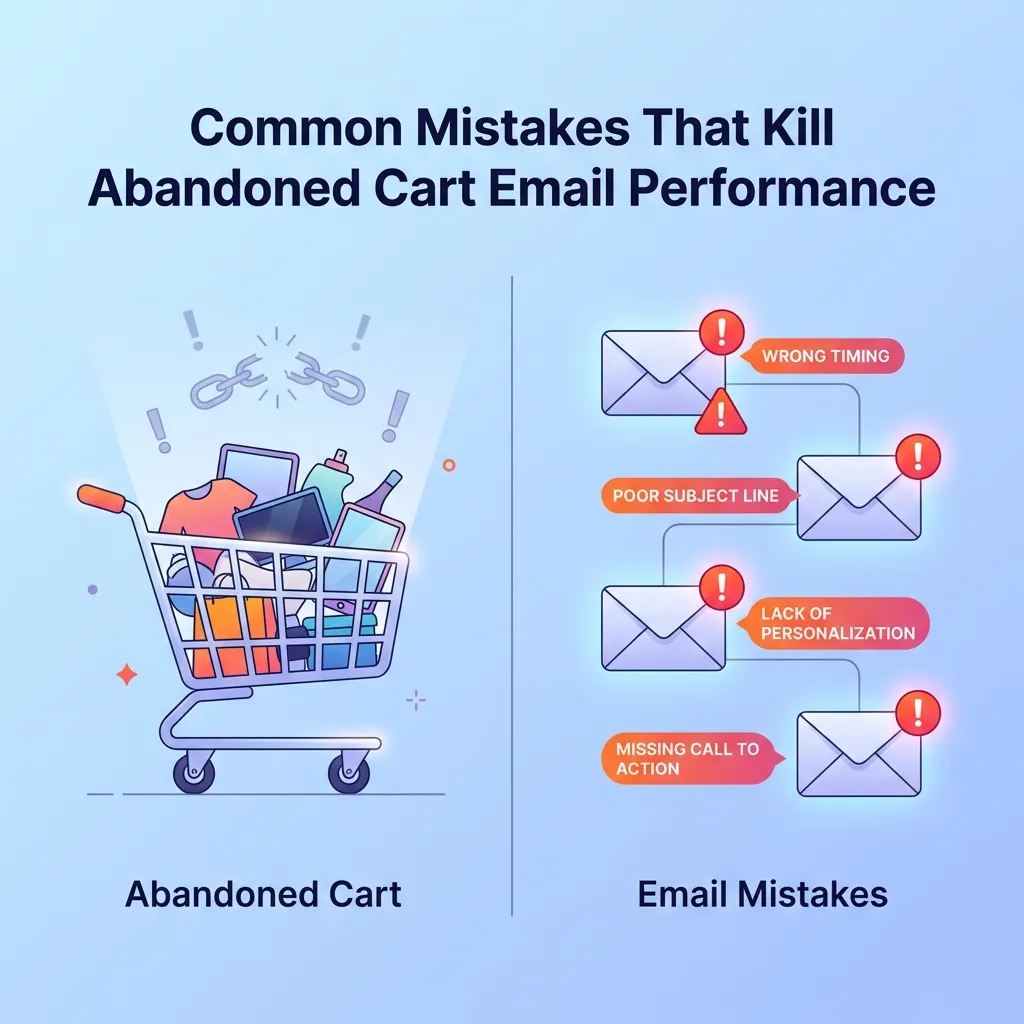
Even a well-intentioned email can fall flat. Watch out for these frequent missteps:
Sending only one email. A single message leaves significant revenue on the table. A three-email sequence consistently outperforms a standalone email. A well-designed drip email marketing sequence ensures each reminder is delivered at the right time.
Offering a discount too early. If you lead with a promo code in Email 1, you train shoppers to abandon carts intentionally, waiting for the offer. Reserve discounts for the final email.
Forgetting mobile optimization. More than half of emails are opened on mobile devices. A poorly formatted email with a hard-to-tap CTA button is a conversion killer.
Neglecting the unsubscribe experience. Shoppers who aren’t ready to buy should be able to opt out easily. A frictionless unsubscribe keeps your list healthy and your sender reputation intact.
Sending at the wrong frequency. Too many emails in too short a window feels aggressive. Stick to the timing framework above and respect your subscriber’s experience.
Measuring Success: The Metrics That Matter
To improve your abandoned cart sequence over time, track these key metrics:
- Open rate — Benchmark: 40–50% for cart abandonment emails (significantly higher than standard campaigns)
- Click-through rate (CTR) — Benchmark: 8–10%
- Conversion rate — Benchmark: 5–10% across the full sequence
- Revenue per email — The clearest indicator of business impact
Run A/B tests regularly on subject lines, send timing, CTA copy, and incentive structures. Small improvements compound quickly when multiplied across thousands of sends.
Turn Abandoned Carts Into Revenue
Cart abandonment is a permanent feature of e-commerce—but it doesn’t have to mean permanent lost revenue. A well-timed, well-structured abandoned cart email sequence is one of the most reliable tools available to recover sales that would otherwise disappear.
Start with a three-email sequence. Nail the timing. Personalize where you can. Address the real reasons shoppers hesitate. And save your incentive for the final message.
The infrastructure is straightforward. The payoff can be substantial. Businesses that focus on eCommerce email marketing consistently see abandoned cart emails become one of their highest-ROI campaigns.
Frequently Asked Questions
How many abandoned cart emails should I send?
Three emails is the standard recommendation. The first goes out within an hour of abandonment, the second after 24 hours, and the third within 48–72 hours. Sending more than three emails within a short window risks annoying shoppers and increasing unsubscribe rates.
Should I always include a discount in abandoned cart emails?
Not in every email—and not in the first one. Offering a discount too early trains customers to abandon carts deliberately to wait for a promo code. Reserve incentives for the third and final email in your sequence.
What is a good conversion rate for abandoned cart emails?
A conversion rate of 5–10% across a full three-email sequence is a solid benchmark. The first email typically converts at the highest rate, given its proximity to the original abandonment event.
What platforms are best for setting up abandoned cart emails?
Klaviyo, Mailchimp, Drip, and Omnisend are popular choices. Each supports dynamic product content, behavioral triggers, and A/B testing. Klaviyo is particularly well-regarded among Shopify merchants for its depth of segmentation and reporting.
Do abandoned cart emails work for all types of e-commerce stores?
Abandoned cart emails perform well across most product categories, but they tend to deliver the strongest results for higher-ticket items where purchase decisions take longer. For impulse-buy products, the urgency window closes faster, making that first email—sent within one hour—especially critical.


I'm Email Marketer who crafts targeted campaigns that drive engagement, nurture leads, and boost conversions. With a passion for creating personalized email strategies.







No Comments