

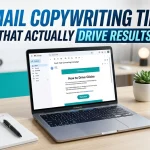
Effective email copywriting requires clear subject lines, personalized content, and persuasive calls to action. By focusing on user benefits over product features, segmenting your audience, and writing concise, mobile-friendly text, email copywriting can significantly improve engagement rates and drive higher conversions.
Email copywriting remains one of the most effective ways to reach and influence audiences directly. While social media algorithms and search engine rankings constantly change, an email list is a valuable asset that businesses fully control. However, successful email copywriting goes beyond simply delivering a message—it requires strategic writing that encourages subscribers to open, read, and take action.
Many marketers struggle with email copywriting because they focus too heavily on promoting products instead of addressing subscriber needs. Readers often skim emails or ignore them altogether when the content lacks relevance or value. Strong email copywriting bridges this gap by aligning business goals with the audience’s interests, challenges, and motivations.
Learning the fundamentals of email copywriting can transform an inactive subscriber list into a powerful marketing channel. This guide explores proven email copywriting strategies for crafting compelling subject lines, engaging body content, and persuasive calls to action that help increase opens, clicks, and overall campaign performance.
How do you write high-converting email copy?
Writing effective sales email copy starts with understanding the primary goal of the email. Every message sent should have a singular, focused objective. When an email asks a reader to read a blog post, buy a product, and follow a social media account all at once, the reader usually does none of them.
What are the best email marketing copywriting techniques?
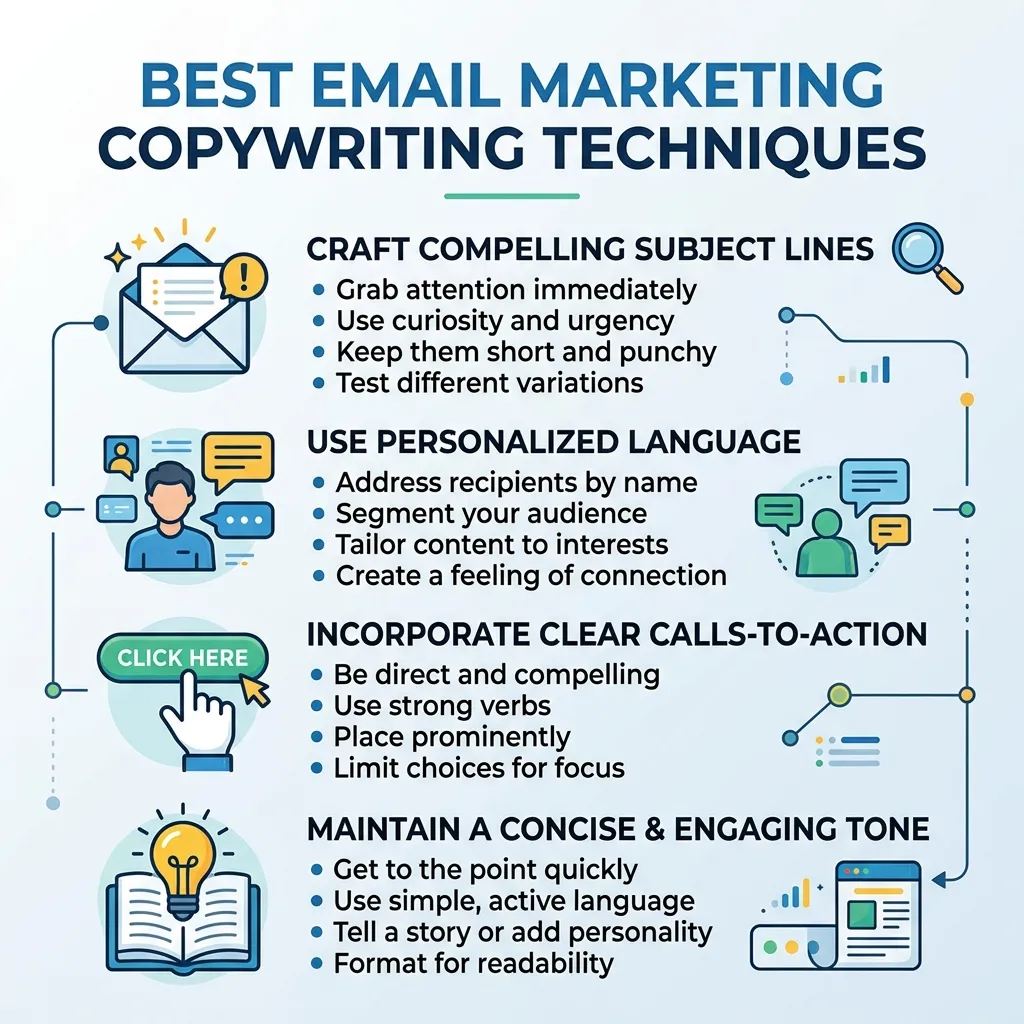
The foundation of strong email marketing copywriting techniques involves writing for a single reader. This customer-focused approach is a core principle of email marketing made simple and helps create more engaging campaigns. Even if you send a campaign to ten thousand subscribers, the recipient reads the message alone. Use the word “you” frequently to make the message feel personal. Replace corporate jargon with everyday language that a person would use when talking to a friend over coffee.
Another core technique is focusing on benefits rather than features. A feature is what a product does; a benefit is how that product improves the reader’s life. For example, a software tool might feature a “cloud-based data syncing protocol.” The benefit to the user is “access your files from anywhere, on any device.” High-converting copy consistently highlights the transformation the user will experience.
How can marketers structure professional email writing?
Professional email writing for marketers does not mean writing stiff, academic text. It means respecting the reader’s time. Structure your emails to be easily scannable. Use short paragraphs, typically no more than two or three sentences. Incorporate bullet points to break up dense information. Bold key phrases so that a reader skimming the text can still understand the main message.
What are the top email subject line optimization tips?
The subject line is the most important sentence in any email campaign. Understanding whether email marketing subject lines should be capitalized can help improve readability and open rates. If the subject line fails to capture attention, the rest of your copy remains unseen. Email subject line optimization tips revolve around clarity, curiosity, and relevance.
First, keep subject lines concise. Mobile devices truncate subject lines after about 40 to 50 characters. Front-load the most important words to ensure the core message is visible.
Second, leverage the power of curiosity without resorting to clickbait. A subject line should hint at valuable information contained inside the email. For example, instead of writing “New Marketing Strategies,” use “The marketing strategy that doubled our open rates.”
Third, personalize the subject line when appropriate. Including the recipient’s first name can boost open rates, but personalization extends beyond names. Mentioning the subscriber’s city, recent purchase, or specific interests makes the email feel tailored to their unique situation.
Which persuasive email writing strategies actually work?
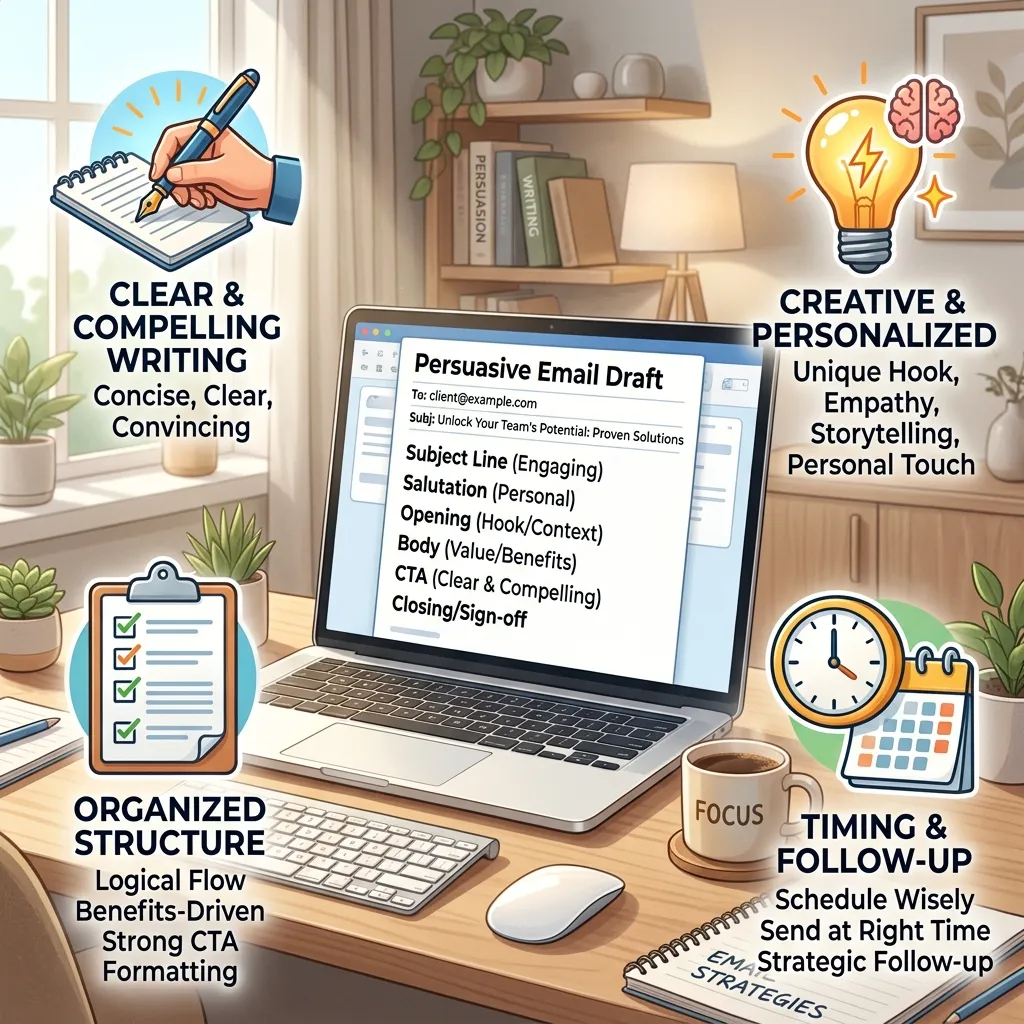
Persuasion in email copywriting relies on understanding human psychology. Effective persuasive email writing strategies utilize frameworks like PAS (Problem, Agitation, Solution).
- Problem: Identify a specific pain point the reader is experiencing.
- Agitation: Describe the negative consequences of leaving that problem unsolved.
- Solution: Present your product or service as the ideal way to resolve the issue.
Another powerful strategy involves social proof. Combined with a strong email funnel, social proof can significantly improve conversions throughout the customer journey. Learn more about creating an email marketing funnel that turns subscribers into customers. People naturally look to others when making decisions. Including a short customer testimonial, a star rating, or a case study snippet builds trust. When a subscriber sees that other people have successfully used your product, they feel more confident in taking action.
Urgency and scarcity also drive conversions. If an offer is available forever, readers will delay taking action indefinitely. Use specific deadlines or limited inventory notices to encourage immediate clicks. However, ensure that the urgency is genuine; artificial deadlines quickly destroy subscriber trust.
What are the best email engagement improvement methods?
Getting readers to open an email is a victory, but keeping them engaged requires a different set of email engagement improvement methods. Interactive content is a highly effective way to keep readers scrolling.
Include simple polls or surveys directly within the email body. Ask questions that encourage subscribers to reply to the email. Email service providers recognize when users reply to campaigns, and this positive engagement helps improve overall deliverability to the inbox.
Storytelling is another powerful engagement tool. Start your email with a brief, relatable anecdote. Humans are wired to respond to narratives. A story creates an emotional connection, making the transition to the sales pitch feel much more natural and less intrusive.
What are the current email marketing content best practices?
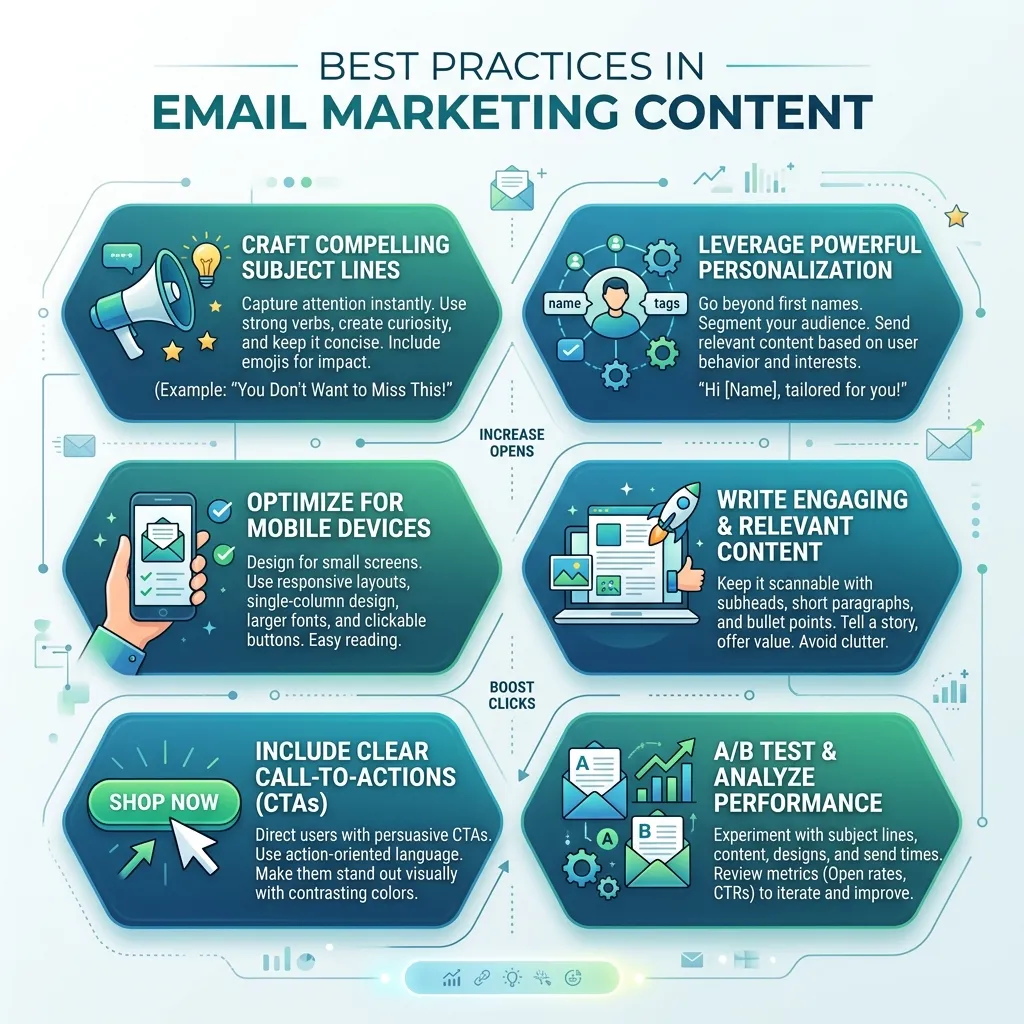
Adapting to current email marketing content best practices ensures your campaigns remain competitive. One major best practice is meticulous audience segmentation. Sending a generic blast to your entire list yields poor results. Group your subscribers based on their past behaviors, purchase history, or stated preferences. A highly targeted email sent to a small segment routinely outperforms a generic message sent to a massive list.
Consistency in brand voice is also crucial. Subscribers should recognize your brand’s tone immediately, whether it is humorous, authoritative, or deeply empathetic. Consistency builds familiarity, and familiarity breeds trust.
Finally, ensure every email is optimized for accessibility. Use large, legible fonts. Provide descriptive alt text for all images so that visually impaired readers—or users with images turned off—can still understand the message. Ensure your color contrasts are sharp enough to be read easily on mobile screens turned to low brightness.
How can you optimize email conversion rates effectively?
Email conversion rate optimization tips focus heavily on the Call to Action (CTA). The CTA must stand out visually and contextually.
Use action-oriented verbs for your buttons. Instead of passive phrases like “Click Here” or “Submit,” use specific commands like “Claim Your Discount,” “Read the Full Guide,” or “Start Your Free Trial.” The button text should complete the sentence: “I want to…”
Reduce friction around the CTA. If you want a user to buy a product, link the button directly to the checkout page with the item already in the cart, rather than linking to the homepage. Every extra click required reduces the final conversion rate.
Always conduct A/B testing on your campaigns. Test two different subject lines, two variations of body copy, or two different CTA button colors. Let data, rather than assumptions, dictate your email strategy. Over time, these incremental improvements lead to massive gains in revenue.
Elevate your email campaigns today
Mastering email copywriting is an ongoing process of testing, learning, and refining. By focusing on your reader’s needs, writing clear and concise copy, and utilizing proven persuasive frameworks, you can dramatically improve the performance of your campaigns. Start by reviewing your next scheduled email. Check if the subject line sparks curiosity, ensure the body copy focuses on benefits, and verify that the call to action is impossible to miss. Small adjustments to your writing can yield incredible results for your business.
Frequently Asked Questions
What is the ideal length for a marketing email?
The ideal length for a marketing email depends on the goal, but most successful promotional emails contain between 50 and 125 words. Keep the text concise to hold the reader’s attention, using short paragraphs and bullet points for easy scanning.
How often should a business send marketing emails?
Most businesses see the best results by sending marketing emails one to two times per week. Sending too frequently increases unsubscribe rates, while sending too rarely causes subscribers to forget your brand.
What is a good email open rate?
A good email open rate across most industries falls between 20% and 25%. However, this metric can vary widely based on your specific niche, the quality of your subscriber list, and how frequently you clean unengaged contacts from your database.
How do I prevent my emails from going to the spam folder?
To prevent emails from landing in the spam folder, ask subscribers to add your email address to their safe sender list. Avoid using excessive exclamation points, writing subject lines in all capital letters, and promoting highly restricted industries without proper authentication (like SPF, DKIM, and DMARC).
Which email metrics should I track to measure success?
To measure the success of your email campaigns, track the open rate, click-through rate (CTR), conversion rate, and unsubscribe rate. The click-through rate is the most reliable indicator of whether your email copy successfully persuaded the reader to take action.


I'm Email Marketer who crafts targeted campaigns that drive engagement, nurture leads, and boost conversions. With a passion for creating personalized email strategies.





No Comments