

Email List Building Services help businesses attract, capture, and grow a qualified subscriber base through opt-in forms, lead magnets, landing pages, and targeted acquisition strategies. The best Email List Building Services focus on quality over quantity, helping brands build engaged audiences, improve deliverability, and turn subscribers into long-term customers through effective nurturing and segmentation.
Email list building services help businesses grow their subscriber base through lead capture tools, opt-in forms, and targeted acquisition strategies. A strong email list remains one of the most valuable marketing assets because it gives brands direct access to their audience without relying on changing algorithms or rising ad costs.
Building a quality subscriber list takes more than collecting email addresses. Successful growth depends on attracting the right audience, offering valuable incentives, and nurturing subscribers over time. Email list building services streamline this process by helping businesses capture, organize, and engage leads more effectively.
This guide explores how email list building works, the different types of services available, and the strategies that help turn subscribers into long-term customers.
What Do Email List Building Services Actually Do?
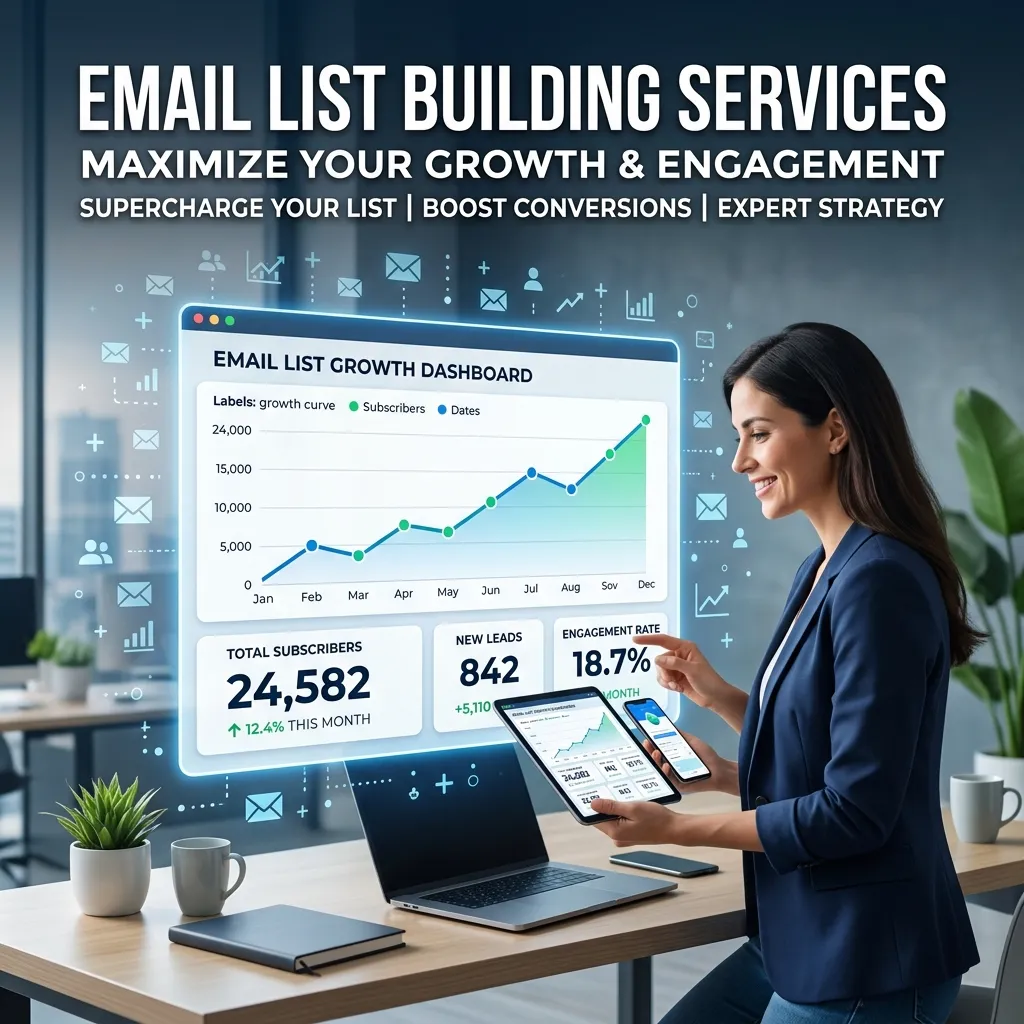
Email list building services are tools or agencies that help businesses capture, grow, and manage a database of email subscribers or prospects. Some focus on inbound opt-in growth—getting website visitors to willingly share their email addresses. Others focus on outbound acquisition, sourcing targeted email contacts for cold outreach or nurture campaigns.
The distinction matters. Opt-in email list growth produces higher engagement rates and lower spam complaints because subscribers have actively expressed interest. Outbound B2B email list building services can accelerate prospecting but require rigorous compliance with data privacy regulations like GDPR and CAN-SPAM.
Most high-growth businesses use both in parallel—building an inbound subscriber base while running targeted outbound campaigns to reach prospects who haven’t yet discovered them organically.
For example, modern systems often rely on automation workflows like those explained in this guide on what email marketing automation is and how it works, which help businesses scale subscriber engagement after capture.
Why Most Email Lead Generation Strategies Stall
The typical email lead generation approach looks like this: add a newsletter signup form to the website footer, drive some traffic, collect a handful of emails per month, and wonder why the list never reaches a meaningful size.
The problem isn’t the channel. It’s the offer.
People don’t hand over their email addresses in exchange for nothing. A generic “subscribe for updates” prompt converts poorly because it communicates no specific value. Subscribers need a reason—a tangible, immediate benefit that makes sharing their email feel worthwhile.
This is where lead capture and email acquisition strategy diverges from list building mechanics. The mechanics (forms, pop-ups, landing pages) are table stakes. The strategy—knowing what to offer, who to target, and how to follow up—is what determines whether a list becomes a genuine revenue asset.
People don’t hand over their email addresses without value. This is why storytelling and emotional relevance matter so much, as explained in email marketing storytelling strategies.
What makes a lead capture offer actually work?
High-converting lead capture offers are often built around urgency, value, and personalization. One of the most effective formats is automated nurturing, especially when combined with structured sequences like those in drip email marketing campaigns. Common formats include:
- Content upgrades: A downloadable resource that extends the value of a specific blog post or page
- Free tools or calculators: Interactive assets that solve a real problem (e.g., ROI calculators, assessment quizzes)
- Discount or early access offers: Particularly effective for e-commerce and SaaS businesses
- Webinars and events: Live or recorded sessions that attract engaged, high-intent subscribers
- Email courses: A multi-part sequence delivered over days or weeks, building habit and expectation from day one
The format matters less than the specificity. A vague “free ebook” performs significantly worse than a “free 5-day email course on reducing churn for SaaS founders”—even if the underlying content is similar—because the latter speaks directly to a defined audience with a defined problem.
Email Subscriber Growth Strategies That Scale

Once the offer is right, scaling email subscriber growth becomes a distribution problem. You need consistent traffic flowing through optimized conversion points.
How do on-site conversion tools affect email list growth?
On-site tools—exit-intent pop-ups, scroll-triggered forms, embedded opt-ins, and dedicated landing pages—can dramatically improve the percentage of visitors who convert into subscribers. Platforms like ConvertKit, Klaviyo, and Mailchimp offer built-in form builders. More advanced tools like Privy, OptinMonster, and Unbounce specialize in conversion rate optimization and offer behavioral targeting features.
The key is matching the right opt-in trigger to the right page and visitor intent. A pop-up offering a discount works well on a product page. A content upgrade offer performs better within or beneath a long-form article. Testing placement, timing, and copy is not optional—it’s the difference between a 1% and a 5% conversion rate, which compounds significantly over time.
What role does content marketing play in building an email database?
Content marketing remains one of the most cost-effective channels for organic email database building. Long-form blog content, SEO-optimized landing pages, and video content attract visitors with high intent, creating natural opportunities to capture email addresses.
The pairing of SEO-driven content with targeted lead capture offers creates a compounding loop: search traffic brings new visitors, optimized opt-ins convert a portion of them into subscribers, and email nurturing converts subscribers into customers—who often refer others, generating more traffic.
For this loop to work, the content and the opt-in offer need to be thematically aligned. A post about email marketing lead generation should offer something directly relevant—a template, a checklist, or a diagnostic tool—not a generic newsletter subscription.
How does paid acquisition fit into an email subscriber growth strategy?
Paid channels—Meta Ads, Google Ads, LinkedIn Ads—can accelerate email list growth significantly, but only when the economics make sense. The key metric is cost per acquisition (CPA): how much it costs to add a single engaged subscriber.
For B2B email list building, LinkedIn Ads’ Lead Gen Forms are particularly effective because they pre-populate subscriber data from profile information, reducing friction at the point of opt-in. For e-commerce and consumer brands, Meta Ads with lead generation objectives can produce high volumes of opt-ins at relatively low cost.
The risk with paid acquisition is volume without quality. It’s easy to build a large list of subscribers who never open emails. Segmenting paid subscribers into their own nurture sequences—and monitoring engagement rates closely—helps separate genuinely interested prospects from list inflation.
B2B Email List Building Services: What to Know Before You Buy

B2B email list building operates differently from consumer email acquisition. Decision-makers are harder to reach, buying cycles are longer, and the consequences of poor targeting are more severe (both for deliverability and for brand reputation).
Several platforms offer targeted email list generation for B2B outreach. Apollo.io, ZoomInfo, Lusha, and Cognism are among the most widely used. These platforms maintain large databases of professional contact information, allowing sales and marketing teams to build prospect lists filtered by industry, company size, job title, geography, and more.
What should businesses look for in a B2B email list building service?
Data accuracy is the first consideration. Outdated or incorrect contact information inflates bounce rates, which damages sender reputation and reduces deliverability across all campaigns. Reputable providers invest in regular data verification and offer bounce guarantees or credit systems for invalid contacts.
Compliance is equally critical. GDPR, CAN-SPAM, and CASL impose strict requirements on how email addresses can be collected, stored, and used. Any B2B email list building service operating in regulated markets should be able to demonstrate how their data is sourced and how consent is documented.
Integration capability matters too. A database tool that connects natively with your CRM (Salesforce, HubSpot, Pipedrive) and email platform reduces manual work and keeps data synchronized across systems.
Opt-In Email List Growth vs. Purchased Lists: A Direct Comparison
The temptation to purchase an email list is understandable. Building one organically takes time. Buying one offers immediate scale. But the tradeoff is rarely worth it.
Purchased lists produce lower open rates, higher spam complaints, and near-zero conversion rates. Worse, sending to non-opt-in contacts violates the terms of service of most email service providers and can trigger regulatory penalties in markets with strict data privacy laws.
Opt-in email list growth is slower, but the subscribers it generates are meaningfully more valuable. They’ve self-selected based on genuine interest, which translates into higher engagement, better deliverability metrics, and stronger lifetime value.
For businesses that need scale quickly, a hybrid model works well: use opt-in growth strategies as the foundation, and layer in targeted outbound prospecting for specific segments where outreach is legally permissible and commercially justified.
Customer Email Acquisition: The Overlooked Source
Existing customers represent the most overlooked source of email acquisition for growing businesses. A customer who has already purchased has demonstrated trust—they’re disproportionately likely to engage with email content, make repeat purchases, and refer others.
Post-purchase email capture, loyalty program sign-ups, and account creation flows all represent high-intent moments to formalize the subscriber relationship. Ensuring these touchpoints are optimized—and that new customers are added to the right segments immediately—closes a gap that many businesses leave open.
The Infrastructure Behind a High-Performing Email List
Even a well-built email list underperforms without the right technical infrastructure. Deliverability—the ability to land in the inbox rather than the spam folder—depends on domain authentication (SPF, DKIM, DMARC records), sender reputation, and list hygiene.
List hygiene means regularly removing unengaged subscribers, processing unsubscribes promptly, and suppressing hard bounces. A smaller, cleaner list consistently outperforms a large, neglected one in both deliverability and revenue metrics.
Email marketing lead generation doesn’t end when someone subscribes. The onboarding sequence—the first few emails a new subscriber receives—sets the tone for the entire relationship. High-performing onboarding flows confirm the opt-in, deliver on the lead magnet promise, introduce the brand clearly, and begin segmenting subscribers based on behavior and interest.
Building an Email List That Actually Converts
The businesses with the most valuable email lists share a common trait: they treat email as a relationship channel, not a broadcast channel. Every opt-in is the start of a conversation. Every email is an opportunity to reinforce relevance, demonstrate expertise, and move a subscriber closer to a decision.
Email list building services—whether platform tools, B2B data providers, or conversion optimization software—are enablers. They provide the infrastructure and the scale. But the strategy, the offer, and the content quality are what transform a list of addresses into a revenue-generating asset.
Start with the offer. Build the infrastructure to capture and nurture at scale. Measure engagement relentlessly. And treat every subscriber as someone who chose to let you into their inbox—because they did.
Frequently Asked Questions
What is an email list building service?
An email list building service helps businesses collect and grow email subscribers through tools like opt-in forms, lead capture software, and prospecting databases.
What’s the difference between opt-in growth and buying an email list?
Opt-in growth involves subscribers who willingly join your list, leading to better engagement and deliverability. Purchased lists often result in low performance and compliance risks.
What are the best ways to grow an email list quickly?
Use a mix of lead magnets, optimized signup forms, paid advertising, and landing pages to attract and convert subscribers faster.
What should I look for in a B2B email list building service?
Focus on data accuracy, compliance, CRM integrations, and reliable prospecting features that help you reach qualified leads.
How can I improve email deliverability?
Keep your list clean, remove inactive contacts, authenticate your domain, and avoid sending emails to purchased or outdated lists.
How important is the lead capture offer?
Very important. Strong offers like templates, guides, tools, or discounts typically generate more signups than generic newsletter forms.


I'm Email Marketer who crafts targeted campaigns that drive engagement, nurture leads, and boost conversions. With a passion for creating personalized email strategies.










No Comments