

Effective email copywriting helps increase opens, clicks, and conversions by using compelling subject lines, personalized messaging, and clear calls-to-action. By focusing on one goal, writing for the reader, and continuously testing your emails, you can create campaigns that build engagement and drive better results.
Effective email copywriting combines compelling subject lines, personalized messaging, and clear calls-to-action to boost open and click-through rates. The highest-converting emails are concise, reader-focused, and built around a single goal—whether that’s a click, a reply, or a purchase.
Most emails get deleted in under three seconds. Not because the offer was bad, but because the copy didn’t earn attention fast enough. With the average office worker receiving 121 emails per day (according to Campaign Monitor), every word in your email has to pull its weight.
The good news? Great email copywriting is a learnable skill. It follows patterns, principles, and techniques that have been tested across millions of sends. Master them, and you can reliably turn a cold inbox into a pipeline of engaged readers, leads, and paying customers.
This guide covers everything from writing subject lines that get opened to crafting calls-to-action that convert—with practical techniques you can apply to your next campaign today.
What Makes Email Copy High-Converting?
Before diving into tactics, it helps to understand what separates a high-converting email from one that gets ignored.
High-converting emails share three core traits:
- Relevance — The message feels personal and timely to the reader
- Clarity — The value proposition is immediately obvious
- Direction — There’s one clear next step the reader is being asked to take
Every tip in this guide connects back to one or more of these principles. Keep them in mind as you write.
Email Subject Line Best Practices: How to Win the Open
Your subject line is the gatekeeper. No matter how good the email copy inside is, none of it matters if the subject line fails to earn a click. According to Optinmonster, 47% of email recipients open an email based on the subject line alone.
What makes a subject line work?
Strong subject lines tend to do one of the following:
- Spark curiosity: “You’re missing something on your website”
- State a clear benefit: “Get 30% more from your next email campaign”
- Use specificity: “3 emails to send before your next product launch”
- Create urgency: “Your free trial expires in 24 hours”
Vague subject lines like “Check this out” or “Quick question” may have worked years ago, but they’ve been overused to the point of invisibility. Readers are savvy—they reward honesty and relevance.
Subject line length and format
Keep subject lines under 50 characters for optimal display on mobile devices. Avoid ALL CAPS and excessive punctuation, which can trigger spam filters and erode trust. If you use an emoji, make sure it reinforces the message rather than distracts from it.
A/B testing subject lines is one of the highest-ROI activities in email marketing. Even a modest improvement in open rate compounds significantly over a large list.
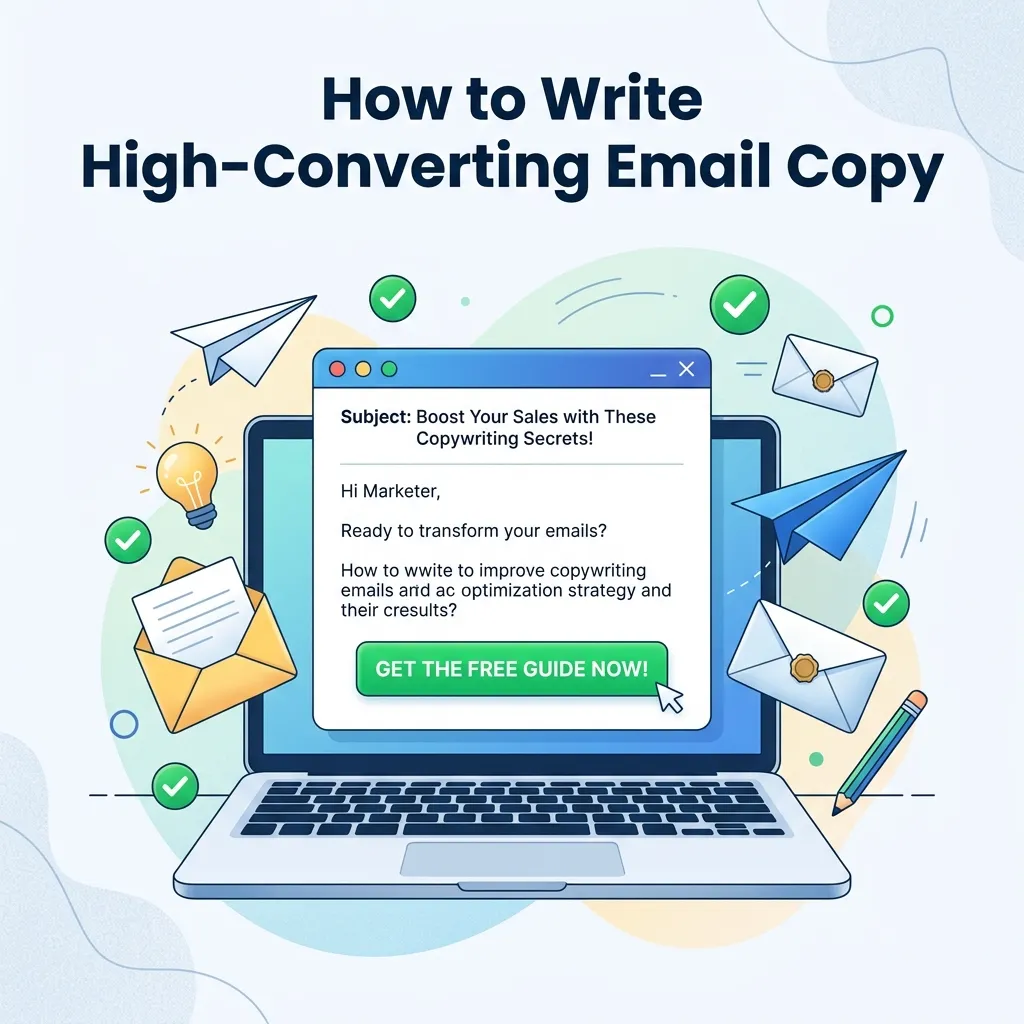
How to Write High-Converting Email Copy
Lead with the reader, not your brand
The most common email copywriting mistake is starting with “We’re excited to announce…” Nobody cares about your excitement—they care about their own problems, goals, and needs.
Flip the framing. Start with the reader’s situation. “Still spending hours editing copy that doesn’t convert?” lands harder than “Introducing our new AI writing tool.” The first sentence should make the reader feel seen.
One email, one goal
Every high-converting email is built around a single objective. Trying to achieve multiple goals in one email dilutes focus and reduces conversions across the board. Building a structured email marketing campaign management process helps keep every campaign focused on one measurable objective.
Before writing a single word, answer this question: What is the one thing I want the reader to do? Everything in the email should serve that goal.
Keep it short and scannable
Most readers scan emails before deciding whether to read them. Use short paragraphs (two to three sentences), bold key phrases, and white space to make your email easy to digest quickly.
A good benchmark: if your email takes longer than 45 seconds to read, it’s probably too long. This doesn’t mean longer emails can’t work—they can, particularly in nurture sequences—but every additional line of copy needs to earn its place.
Write like a human
Formal, corporate-sounding email copy creates distance. Readers trust and engage with writing that sounds like it came from a real person who understands their situation.
Read your email out loud before sending it. If it sounds stiff or unnatural, rewrite it. Use contractions. Use short sentences. Don’t be afraid to start a sentence with “And” or “But.”
Email Personalization Techniques That Go Beyond First Names
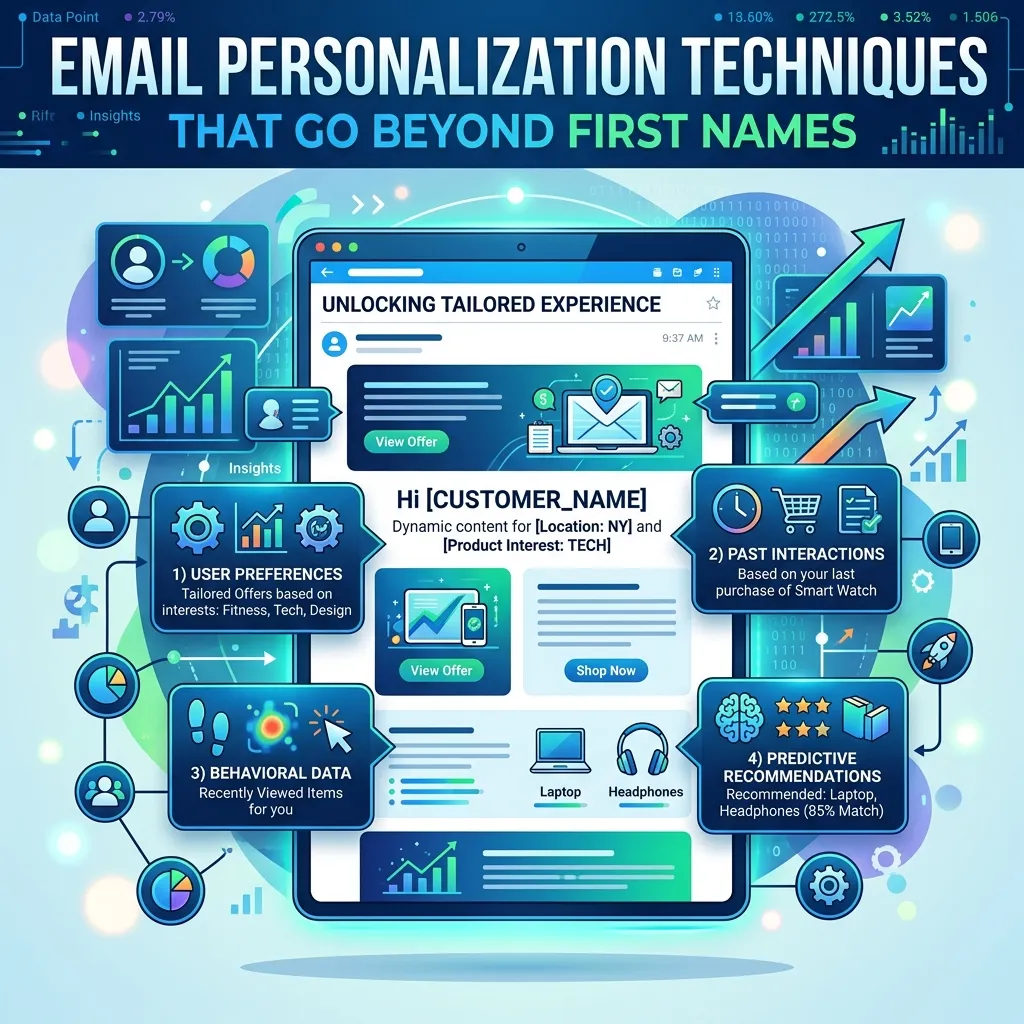
Personalization is one of the most powerful levers in email marketing. According to HubSpot, personalized emails deliver six times higher transaction rates than generic ones. But personalization done poorly—like inserting a first name into a generic mass email—doesn’t move the needle.
Segmentation and personalization go hand in hand. A message written for everyone ends up resonating with no one. Learning effective email segmentation strategies allows you to send more relevant messages that consistently improve engagement.
Behavioral and contextual personalization
The most effective personalization is based on behavior, not just demographics. Some examples:
- Browse behavior: “You checked out [Product]—here’s what other buyers said about it”
- Purchase history: “Based on your last order, you might also like…”
- Engagement history: Re-engagement emails triggered when a subscriber hasn’t opened in 60+ days
- Stage in the funnel: New subscribers get onboarding emails; active users get upsell emails
Segment before you write
Segmentation and personalization go hand in hand. A message written for everyone ends up resonating with no one. Segmenting your list by factors like industry, company size, behavior, or lifecycle stage allows you to tailor your messaging in ways that feel genuinely relevant.
Even simple two-way segmentation—new vs. returning customers, for example—can dramatically improve response rates.
Persuasive Email Writing Tips: The Psychology Behind Clicks
Persuasive email copy isn’t about manipulation. It’s about understanding what motivates your reader and presenting your offer in a way that aligns with those motivations.
Use social proof strategically
People look to others when making decisions. Including specific social proof—customer testimonials, usage statistics, or case study results—makes your claims credible and your offer more compelling.
Specificity matters here. “Thousands of marketers love us” is easy to dismiss. “Over 12,000 marketing teams use [Brand] to write email campaigns faster” is not.
Address objections head-on
Every reader has unspoken objections. Price, effort, risk, and relevance are the most common. High-converting email copy anticipates these objections and dismantles them before they become a reason to ignore the CTA.
For example: “Setup takes less than five minutes—no technical knowledge required” speaks directly to a reader who fears complexity.
Use the PAS framework
Problem → Agitate → Solution is one of the most reliable frameworks in copywriting, and it works particularly well in emails.
- Problem: Name the specific pain point your reader faces
- Agitate: Deepen the sense of urgency or frustration around that problem
- Solution: Present your offer as the clear resolution
This structure works because it meets the reader where they are emotionally before presenting a logical case for action.
Sales Email Copywriting Strategies for Cold and Warm Outreach
Cold email copy: earn trust before asking for anything
Cold emails fail when they lead with the pitch. A cold prospect doesn’t know you, doesn’t trust you, and didn’t ask to hear from you. Your first job isn’t to sell—it’s to establish relevance and credibility quickly.
A strong cold email structure:
- Opening line: A specific, personalized observation about the prospect or their business
- Value statement: One sentence explaining what problem you solve
- Social proof: A brief, relevant example or result
- Low-commitment CTA: Ask for a reply or a quick call, not a purchase
Keep cold emails under 150 words. Brevity signals respect for the reader’s time.
Warm email copy: deepen the relationship
Emails sent to warm leads or existing customers can be longer and more detailed. These readers already have a relationship with your brand, so the trust barrier is lower. Focus on deepening value, sharing relevant insights, and guiding them toward the next logical step in their journey.
Email CTA Writing Tips: The Difference Between Passive and Powerful
The call-to-action is where the conversion happens—or doesn’t. Most CTAs underperform because they’re generic (“Click here”, “Learn more”) or buried at the bottom of a long email.
Multiple CTAs split attention and reduce conversions. Pick the single most important action and make it the focal point of the email. These principles are also covered in our guide on writing marketing emails that actually get results.
Write CTAs that speak to outcomes
Instead of labeling the action, label the benefit. Compare these two CTAs:
- Weak: “Download the guide”
- Strong: “Get my free email swipe file”
The second version is written from the reader’s perspective and speaks to what they’ll get, not what they’ll do.
Use one CTA per email
Multiple CTAs split attention and reduce conversions. Pick the single most important action and make it the focal point of the email. If you must include a secondary link, keep it visually subordinate to the primary CTA.
Make the CTA visually prominent
Whether you’re using a button or a hyperlinked line of text, the CTA needs to be easy to find—especially on mobile. Use enough white space around it that it stands out, and place it where the reader’s attention naturally falls after reading the email body.
How to Improve Email Open and Click-Through Rates Over Time
Strong email copywriting is part art, part science. The science part comes from consistent testing and measurement.
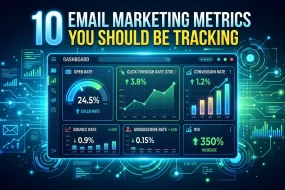
Metrics to track
- Open rate: Indicates subject line and sender name performance
- Click-through rate (CTR): Reflects how compelling the email body and CTA are
- Click-to-open rate (CTOR): The ratio of clicks to opens, which isolates copy performance from deliverability variables
- Conversion rate: Measures how many email clicks resulted in the desired action
Build a testing cadence
Test one variable at a time—subject line, sender name, CTA copy, email length, or opening line. Run each test long enough to reach statistical significance before drawing conclusions. Over time, these incremental gains compound into a meaningfully better-performing email program.
The Bottom Line: Write for Humans First
Email copywriting is ultimately about human connection. The most sophisticated segmentation and the cleverest subject line formulas are all in service of one thing: making a real person feel like an email was written specifically for them, and giving them a compelling reason to act.
Start by understanding your reader deeply—their goals, frustrations, and objections. Write with clarity and intention. Test relentlessly. The campaigns that consistently outperform aren’t the product of a single brilliant insight; they’re the result of a disciplined process of writing, measuring, and improving.
Apply the principles in this guide to your next campaign, and you’ll have a concrete foundation to build on.
Frequently Asked Questions
What is email copywriting?
Email copywriting is the practice of writing persuasive, goal-oriented content for email campaigns. Email copywriting encompasses subject lines, body copy, and calls-to-action, all written to prompt a specific reader response such as clicking a link, making a purchase, or replying to a message.
How long should a marketing email be?
Most marketing emails perform best when they’re concise—typically between 50 and 200 words for promotional campaigns. Nurture emails and newsletters can be longer if the content consistently delivers value. The right length depends on your audience, goal, and where the subscriber is in their journey.
How do I improve my email click-through rate?
To improve email click-through rates, focus on three areas: relevance (is the email speaking to the right segment?), copy clarity (is the value proposition immediately obvious?), and CTA strength (is the call-to-action benefit-focused and visually prominent?). A/B testing each of these elements systematically is the fastest path to improvement.
What’s the best way to personalize email copy?
The most effective email personalization goes beyond inserting a subscriber’s first name. Behavioral personalization—triggered by actions like browsing, purchasing, or going inactive—produces significantly higher engagement than static demographic personalization. Segmenting your list and writing copy tailored to each segment is the foundation of a strong personalization strategy.
How do I write a subject line that improves open rates?
High-performing subject lines are specific, relevant, and honest. They work best when they spark curiosity, clearly state a benefit, or create genuine urgency. Keep subject lines under 50 characters for mobile readability, and always A/B test at least two versions to identify which approach resonates with your audience.
What is the PAS framework in email copywriting?
PAS stands for Problem, Agitate, Solution—a copywriting framework that structures email copy by first naming the reader’s pain point, intensifying the urgency around it, and then presenting the offer as the clear resolution. The PAS framework is effective because it connects with the reader emotionally before presenting a logical case for action.


I'm Email Marketer who crafts targeted campaigns that drive engagement, nurture leads, and boost conversions. With a passion for creating personalized email strategies.

No Comments